Showing posts with label #funny #lol #joke #hilarious. Show all posts
Showing posts with label #funny #lol #joke #hilarious. Show all posts
Sunday, February 4, 2018

Wednesday, April 19, 2017
Alex Jones And The Dark New Media Are On Trial In Texas

Infowars / Getty
AUSTIN, Tx — Halfway through the second official day of his 10-day civil custody trial, Alex Jones reclined in his chair and mopped sweat from his brow while watching a shirtless, pantsless version of himself hawk male vitality supplements on a courtroom television screen. It was hardly the most outlandish moment of the afternoon.
Indeed, the first full day of Jones’ battle to retain custody of his three young children was filled with bizarre allegations — claims that Jones took his shirt off during a joint family counseling session and once blamed his inability to recall basic facts about his children during a pre-trial deposition on having “had a big bowl of chili for lunch."
The news from the Travis County courtroom — breathless tweets from a gaggle of journalists covering the trial — bled across the internet instantly. Since Sunday evening, when the Austin American Statesman broke the news that Jones’ attorneys planned to defend his custody on the grounds that his two-plus decades of conspiracy theorizing has been “performance art,” Alex Jones' name and reputation have unexpectedly become one of the biggest stories in the country.
And while it’s unusual for a contentious family custody case to end up as fodder for late night television hosts (the Jones case got the extended Colbert monologue treatment on Monday evening), Jones’ trial is far larger than his painful and in some ways ordinary family dispute. For the millions on either side who both adore and revile Jones, the case offers the hope of answering a near-impossible question: where does Alex Jones the character end and Alex Jones the person begin?
But the herculean task of untangling Jones from his political views has put the 43 year-old broadcaster at the center of something bigger than himself. Unexpectedly, Jones is now the star of a courtroom drama that feels less like a quotidian family law case and more like a referendum on politics, the internet, and the media in the post-Trump ecosystem.
And that’s because at present Jones and his Infowars media empire sit at the intersection of the thorniest issues across the media landscape. Jones, depending on who you ask, is either a participant in, defender of, or the driving force behind everything from fake news, online harassment and conspiracy theories to the toxic, hyper-partisan politicization of seemingly innocuous events.
Which is what makes Jones’ trial — and his impending trip to the witness stand — so alluring. Perhaps less interesting than knowing exactly what Jones truly believes is the prospect of watching legal experts compel earnest testimony from one of the nation’s top exporters of loose facts, untruths, and partisanship. Jones’ unenviable position then — disavow your lucrative professional views or risk losing your family — feels like a rare shot at the truth at a time when disinformation and professionalized trolling are staples of both sides of the political spectrum.
And while Jones’ verdict will likely set few precedents when it comes to internet conspiracy theorizing, the national scrutiny is bound to imbue even the smallest rulings with added meaning. Jones’ performance art defense resonates deeply during a month in which CNN’s President Jeff Zucker prompted outrage by comparing political news coverage to a sporting event. Similarly, Judge Orlinda Naranjo’s decisions to admit or disallow Jones’ rants into evidence seem — perhaps unfairly — referendums on fake news. Mix in the trial’s custody element and the case’s rulings grow unanswerable and near-existential to an outside observer: can someone who trafficks in fake news simultaneously be a good father? Just how amoral are conspiratorial thoughts when they’re published for a wider audience?
And because Jones and the Infowars empire are creatures of the internet, the trial stands to put the engines and platforms of information distribution on trial in unexpected ways. On Tuesday there was confusion in the court as to whether Jones’ impromptu Facebook Live streaming videos — which depict him shouting at protesters and slurring words ahead of Donald Trump’s inauguration — should be classified as part of Jones’ professional life or if they were videos of a more personal nature, given that they weren’t shot in studio. There’s even a debate to be had over the legal sincerity of certain online threats. Jones’ parenting, for example, was called into question Tuesday by the opposing counsel for bringing his 14 year-old son onto his streamed radio after having received death threats online during his broadcasts.
And if you’re looking to understand how alternative political and factual universes respond to news about polarizing figures, the first two days of Jones’ trial have been highly instructive. Jones’ attorney’s performance art defense was met by the mainstream media as an ideological checkmate of sorts while his defenders reflexively blamed the claims on a deeper, more sinister conspiracy. Jones himself denied the rumors and claimed that the media was doing to him what they claim he does: take a kernel of truth and spin it to fit a convenient fake news narrative. Jones’ critics react incredulously while his fans argue it’s unfair to politicize what should be a private family matter. All sides talk past each other, ignoring the other and assuming they've won.
This local custody trial is not supposed to be about Alex Jones. And yet his centrality to the proceedings is unavoidable. Still, despite the fact that this is at its core a family matter and an examination of Jones’ dueling personae, it is hard to shake the feeling that there’s something greater looming over the 10 days. This is the 21st century media’s century’s Scopes Monkey Trial (we are the lower primates here, not the earnest schoolteacher), and the trial’s symbolic meaning will overshadow its subjects, litigants, and even its verdict. Instead, it standing in as a referendum on a divisive moment, to be interpreted differently by all who follow along. Trials with media personalities highlight this further. Last year’s Hulk Hogan lawsuit against Gawker Media was largely viewed as a condemnation of a bygone era of sensationalist online writing and reporting. And in its own overdetermined way, Jones’ trial, coverage, and fallout feels a bit like a trial for the media — with all its attendant volatility and uncertainty and toxicity — in the year 2017.
We are riveted to our olive green, cushioned seats in the gallery of the Travis County Courthouse this week because of Jones’ profound influence — both intentional and unintended — on our politics, culture, and on a conspiratorial ideology of fear that transcends party lines. The case of Jones v. Jones resonates so deeply at this moment because we are living in a moment that Alex Jones himself ushered in.
Tuesday, April 18, 2017
Facebook’s New Camera Could Make It Even Harder To Tell What’s Real

Stephen Lam / Reuters
Onstage this morning at Facebook’s annual developer conference, Mark Zuckerberg used the image of an ordinary coffee cup — displayed on the gigantic screen above him — to demonstrate Facebook’s new in-app camera, which uses superior artificial intelligence to recognize objects and then seamlessly manipulate them. Facebook’s software will know it’s a mug — just tap on the coffee and a toolbar will pop-up with relevant effects like a cloud of steam. Or, said Zuckerberg, “you can add a second coffee mug, so it looks like you’re not having breakfast alone.”
Without naming his muse — Snapchat — Zuckerberg told the crowd of thousands that Facebook is ready to take augmented reality mainstream, to make it accessible to anyone with a smartphone. On stage, Zuckerberg ran through the primary use cases for Facebook’s camera, including adding digital objects, a la Pokemon Go, or the ability to “enhance digital objects like your home or your face.” Facebook CTO Mike Schroepfer, chief technology officer, offered a more seasonal example: “Let’s say I took a wonderful vacation photo and a windsurfer rudely interrupted my view.” With Facebook’s camera, the offending surfer could be easily edited out, Schroepfer explained, using a slide screen to show just how easy it was rewrite vacation history.
The examples sounded as innocuous as could be, until you considered how they might play out in the real world. In the keynote, Facebook floated right past questions like: Can Facebook’s camera erase a man on dry land from a photograph as easily as it can a windsurfer? Are there realistic-looking items can Facebook instantly insert into a photo? In other words, just how much will people be able to doctor the photos that appear in their feeds? And will the people who see them know they’ve been manipulated?
Facebook didn’t demonstrate this trick on stage, but during an earlier interview, the company showed BuzzFeed News how its radical camera could take an ordinary photo of a person and manipulate their facial expression to make the person smile, or frown, or display whatever other emotion the smartphone-holder desired. Back in December, the Verge warned that artificial intelligence was already making it easy to make fake images and fake videos, pointing to a startup called SmileVector that can make any celebrity smile.
To be clear, many of the effects available now — like breakfast sharks flying around Zuckerberg’s cereal bowl — are clearly cartoons. Facebook declined to comment on the record, but the company's Camera Effects Platform is still in closed beta: effects have to be submitted and reviewed by Facebook before being shared. Each effect also has to adhere to Facebook’s policies and terms governing what’s offensive or illegal. The company monitors how effects are being used and will update accordingly.
But soon enough, these tools will soon be distributed to nearly two billion users, with frictionless ease. And, as Zuckerberg said many times on stage, they’re still primitive. That's an interesting posture for a company with a major fact-checking problem that has seen time and again the way its products can be used to foster hate speech, violence, and division. It's worth noting that a recent report about Silicon Valley reengineering journalism, traced fake news opportunists back to Zuckerberg’s (seemingly benign-sounding) goal from 2014 to build a personalized paper.
We don’t know how Facebook Camera and the products built on it will be used in the real world until they're, well, out in the real world, in the pockets of a billion-plus people — some of whom are assholes (or Macedonian teens). The people who use technology are, all too often, more creative than those who make it: They find new and ingenious ways to hack the algorithm, evade the censors, further their agendas, and make certain topics go viral. Facebook’s new camera effects could very well end up being an innocuous way to make breakfast fun and fix your vacation pictures — or it could mean we’ll soon be a nation divided over fake photos instead of fake news. In the meantime, that steam sure is cool.
We Tried Out Facebook's New Social VR App At F8

SAN JOSE — Facebook announced a new social virtual reality app for its Oculus Rift headset today at F8, the company's annual conference for software developers. It's called Facebook Spaces, and you can download the beta version from the Oculus Store now.
In her keynote address, Rachel Rubin Franklin, Facebook's head of social VR, said that Spaces signaled "the very beginnings of social VR." People on Twitter said it looked a lot like Second Life and The Sims. Perhaps not coincidentally, Franklin previously worked as vice president at Electronic Arts managingThe Sims game.
Oculus Rift already supports the social game Altspace VR, made by an independent game publisher of the same name, where people can gather in virtual rooms via human or robot avatars and host events, play games, make art, watch 2D videos, or socialize.
Here's how Spaces works:
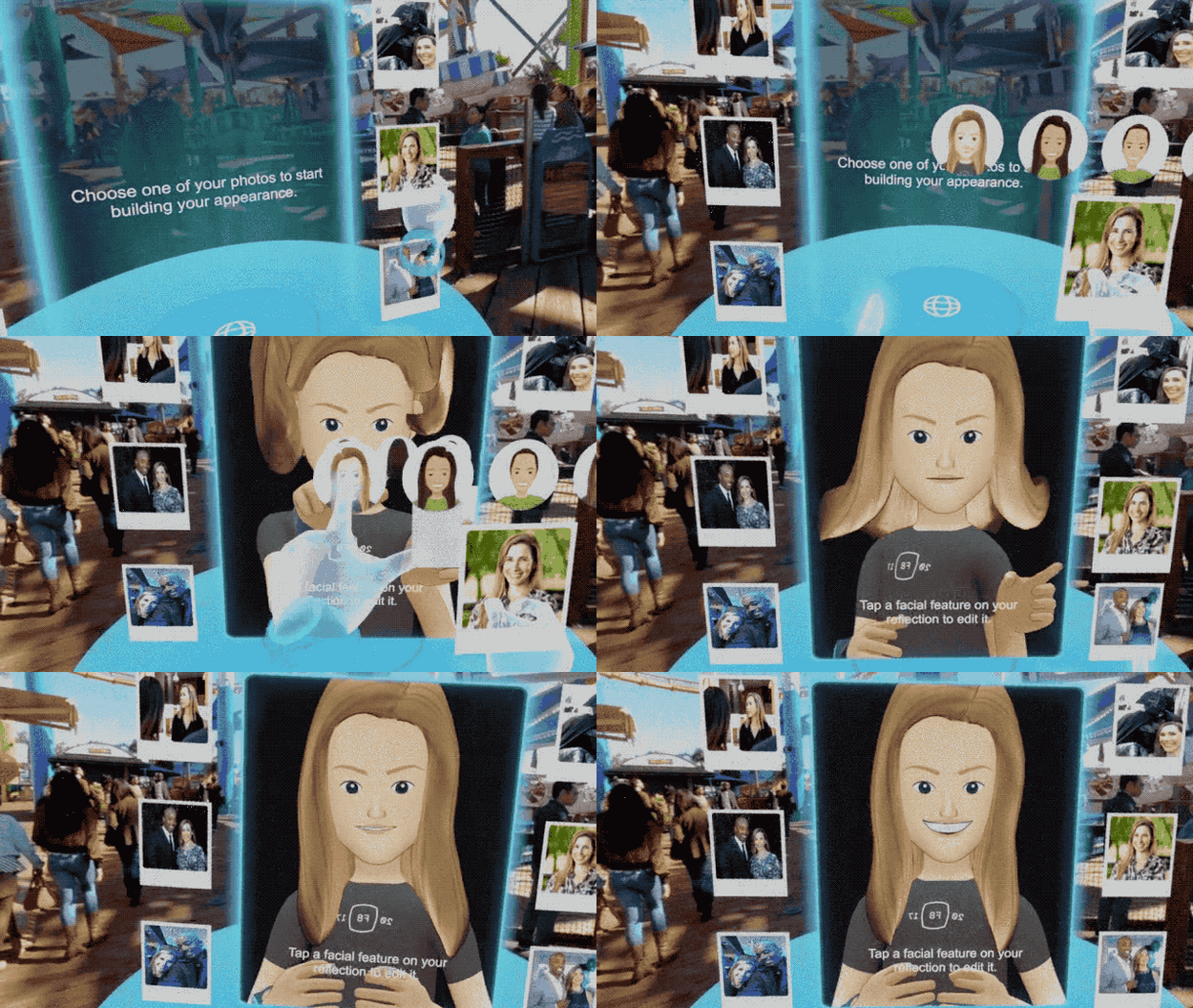
First, you connect your Facebook account to Spaces in the "Devices Requests" tab of the Facebook mobile app. Then you'll strap on your Rift headset and navigate to the Spaces app, which will appear in your library. You'll need the Rift Touch controllers, which retail at $100 a pair, to use Facebook Spaces.
To create your virtual self, you choose from several versions of an avatar whose features are drawn from scans of your Facebook photos. You can customize some features, like hair, eye color, and glasses. The majority of the avatars seem to have large foreheads.
You can invite up to three friends to your space.
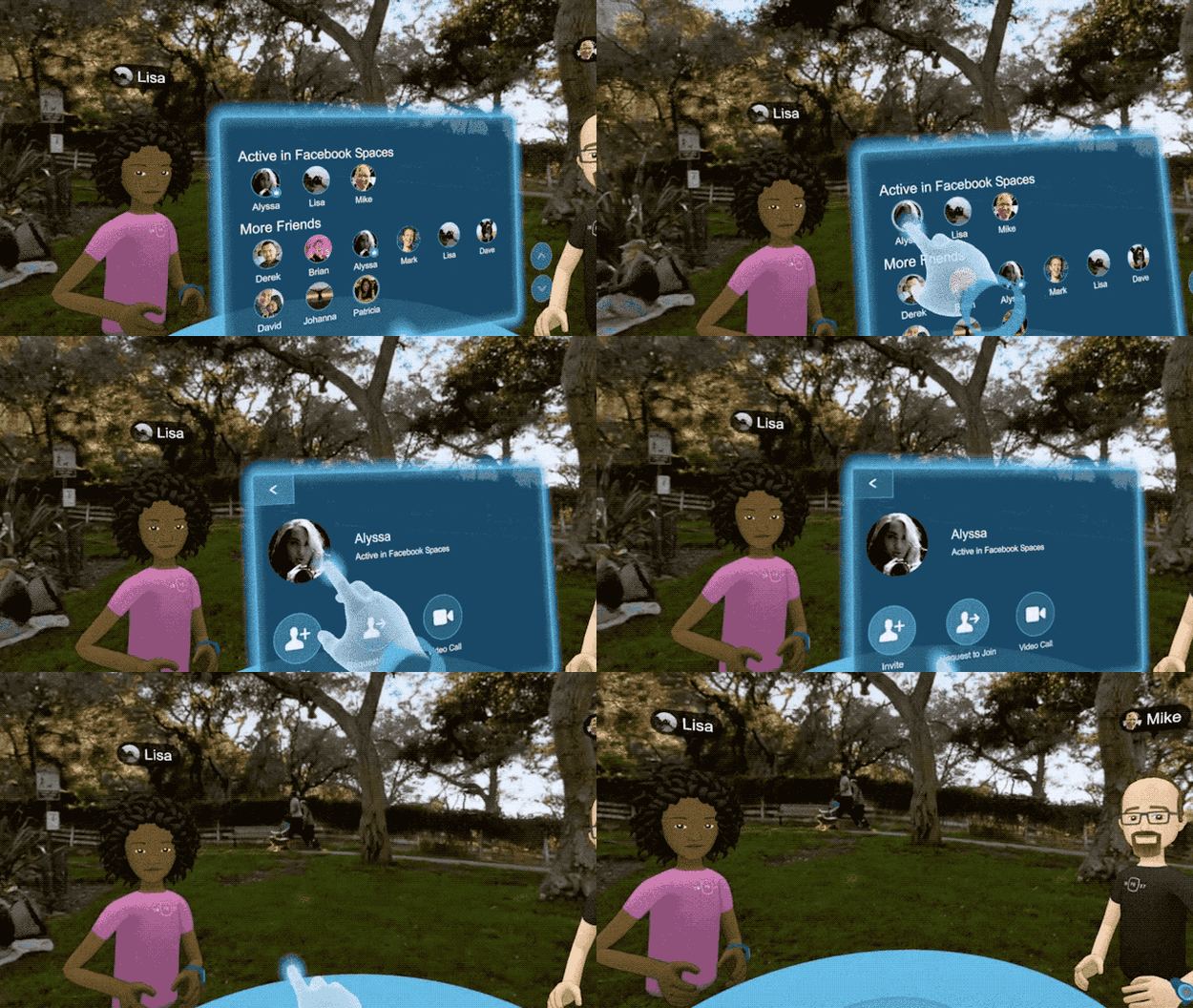
If they accept, you'll find yourselves sitting around a virtual table. They'll see your virtual avatar and the backdrop behind it. (You can choose from default backgrounds or use your own 360 pictures.) Your avatar can also video call friends via Messenger, which you can pull up as a flat menu in the virtual space. The video will appear as a 2D screen that you'll be able to grab and move around. If they're not in Facebook Spaces when you call, you'll see their IRL face and surroundings, and they'll see your avatar and your virtual setting.
If you get tired of your friends, Facebook included the ability to mute them or wholesale remove them from your virtual space. Gurl, bye.
Here's a friend appearing!
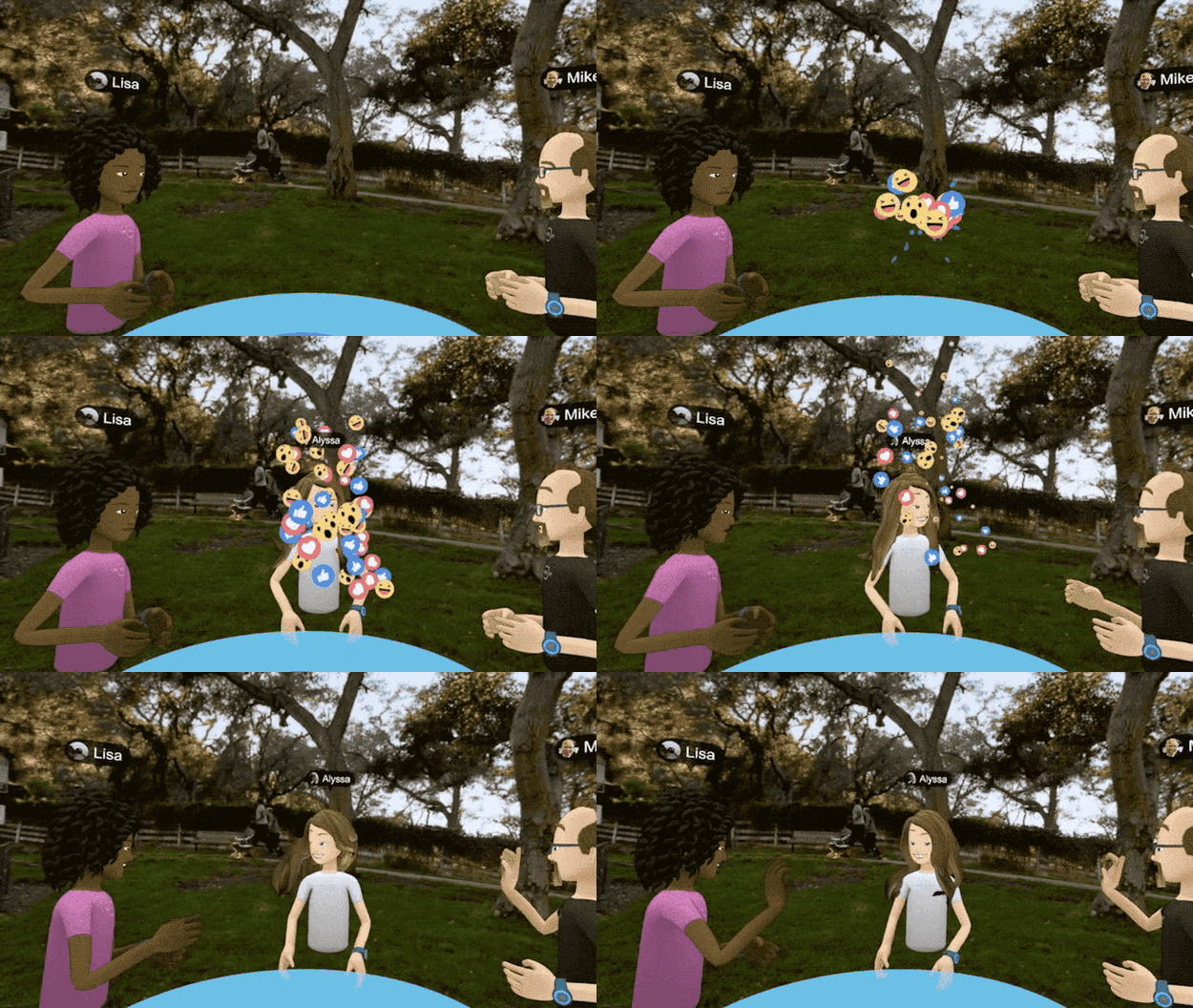
To entertain yourselves, you can draw in 3D and take selfies.
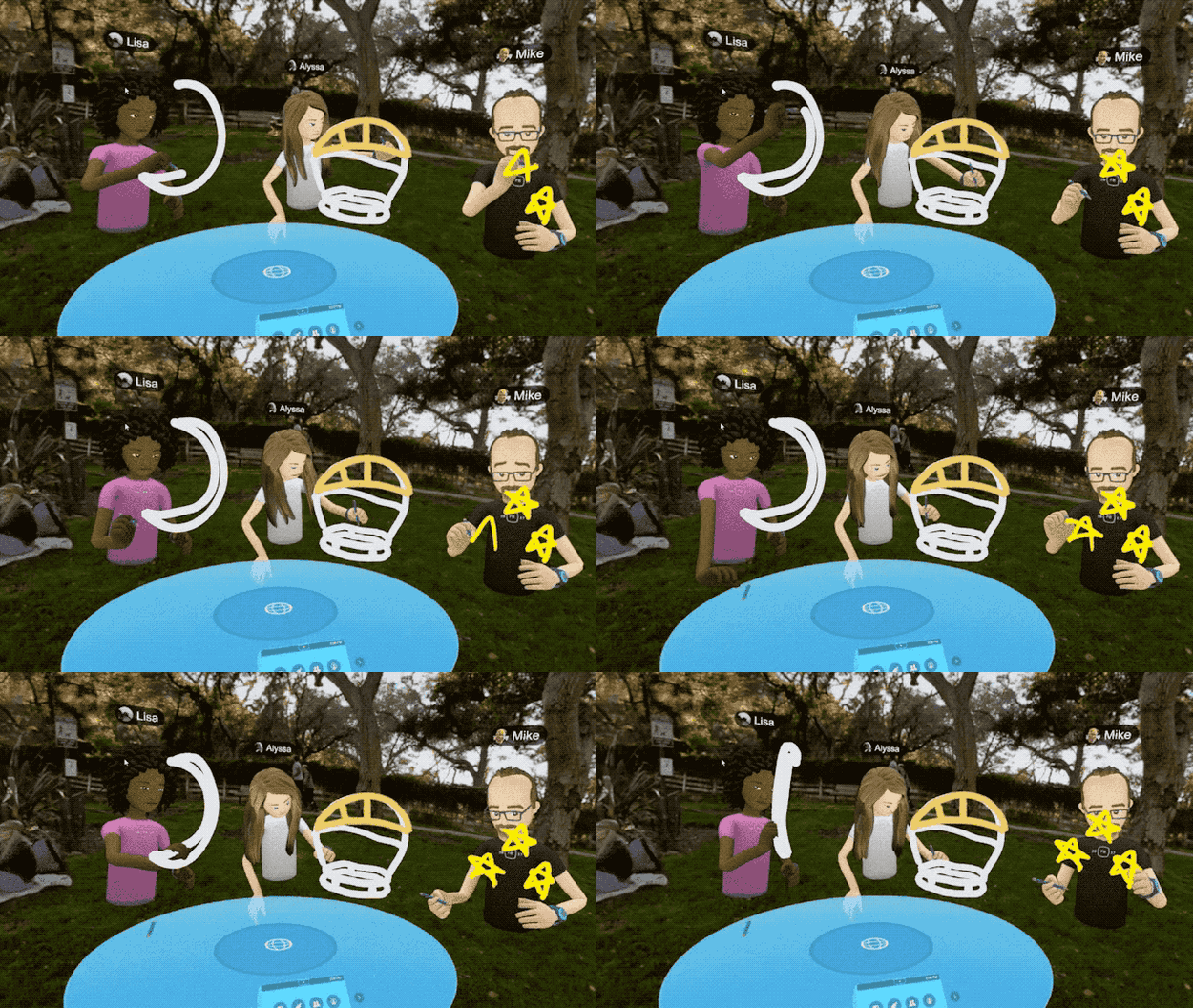
Here's my virtual selfie with Christian, who works at Facebook.
I was really into the 3D marker. He was unamused.
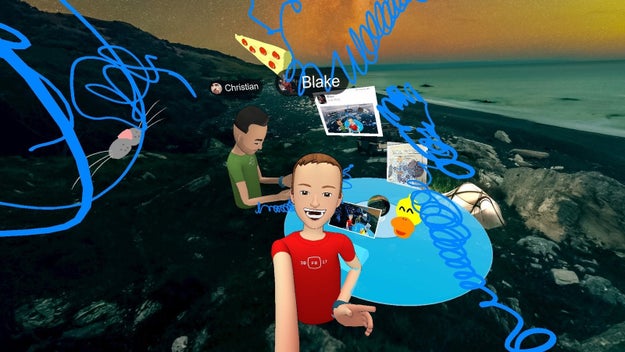
And here's BuzzFeed video producer Allyson Laquian's selfie, where she has a piece of pizza in her head.
The background is a 360 video of the Pyramids of Giza in Egypt.
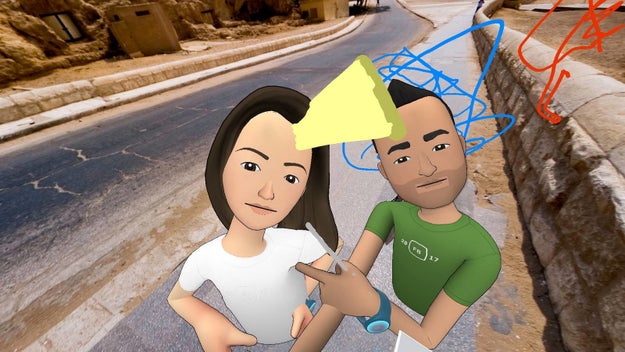
360 videos can totally change your environment
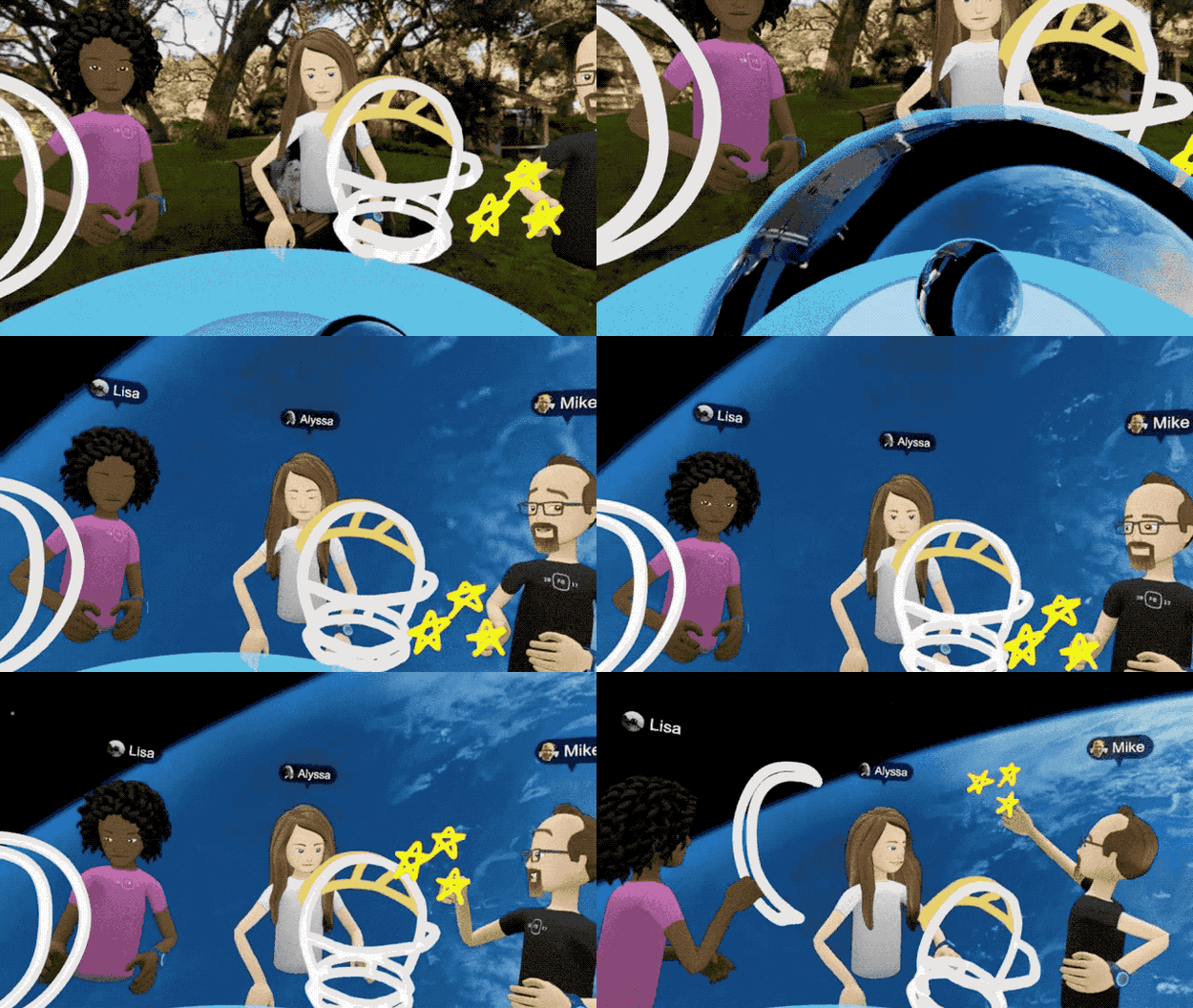
To play a 360 video, you'll open a menu of options using the virtual control interface, and you select from content Facebook publishers have made or that you've recorded. When you grab a video from that menu, it'll appear as a small orb in your virtual hand. To play it you can either put it in your avatar's mouth or in the center of the communal table.
The videos will play all around you, turning your virtual environment into the video. You'll also be able to view two-dimensional videos and pictures from Facebook publishers and your own timeline within Spaces as movable flat screens.
Facebook said in a statement that it's hoping to bring the app to more platforms in the future but didn't specify which ones.
Climbing Out Of Facebook's Reality Hole

Getty Images
SAN JOSE — It is spring in California and the rains have finally returned after years of absence. The grass is green, the hillsides are coated in yellow and orange and blue flowers, and the reservoirs are full again, hallelujah. Yet while the Spring rains may have washed away the drought, they have done nothing to alleviate the sense of existential dread — especially pervasive here in the techno-utopia of California —that the world we built has perhaps gone badly awry.
The proliferation of fake news and filter bubbles across the platforms meant to connect us have instead divided us into tribes, skilled in the arts of abuse and harassment. Tools meant for showing the world as it happens have been harnessed to broadcast murders, rapes, suicides and even torture. Even physics have betrayed us! For the first time in a generation, there is talk that the United States could descend into a nuclear war. And in Silicon Valley, the zeitgeist is one of melancholy frustration and even regret — except for Mark Zuckerberg, who appears to be in an absolutely great mood.
The Facebook CEO took the stage at the company's annual F8 developers conference a little more than an hour after news broke that the so-called “Facebook Killer” had killed himself. But if you were expecting a somber mood, it wasn't happening. Instead, he kicked off his keynote with a series of jokes.
It was a stark disconnect with the reality outside, where the story of the hour concerned a man who had used Facebook to publicize a murder, and threaten many more. People used to talk about Steve Jobs and Apple’s reality distortion field. But Facebook, it sometimes feels, exists in a reality hole. The company doesn’t distort reality — but it often seems to lack the ability to recognize it.
You have to build for the reality we live in, not the one we hope to create.
The problem with connecting everyone on the planet is that a lot of people are assholes. The issue with giving just anyone the ability to live broadcast to a billion people is that someone will use it to shoot up a school. You have to plan for these things. You have to build for the reality we live in, not the one we hope to create.
While Zuckerberg has charted a statesmanlike evolution over the years, he and the company he helms too often have a blind spot for the way the world will react to products it unleashes on them. Certainly, that seemed the case at F8 today where a slightly rain-soaked audience groaned through Zuckerberg’s dad jokes and listened in anticipation as he teased what was to come. Then, abruptly, he shifted gears.
“Our hearts go out to the family and friends of Robert Godwin Sr.,” Zuckerberg said, referring to the 74 year-old victim. “We have a lot of work and we will keep doing all we can to prevent tragedies like this from happening.” Then, as quickly as he hit the somber tone, Zuckerberg returned to platform optimism.
Todays news was largely about the company’s push into AR - augmented reality. Think: digital layers we can place atop the real world. Facebook says there will be three main ways this will play out: The ability to display information on top of the world in front of you, the ability to add digital objects, and the ability to enhance or alter existing objects.
Executive after executive took the F8 stage to show off how these effects will manifest themselves in the real world. Deborah Liu, who runs Facebook’s monetization efforts, encouraged the audience to “imagine all the possibilities” as she ran through demos of a cafe where people could leave yelp style ratings tacked up in the air and discoverable with a phone, or a birthday message she generated on top of an image of her daughter, while noting that with digital effects “I can make her birthday even more meaningful.”
And yet the dark human history of forever makes it certain that people will also use these same tools to attack and abuse and harass and lie. They will leave bogus reviews of restaurants to which they’ve never been, attacking pizzerias for pedophilia. If anyone can create a mask, some people will inevitably create ones that are hateful.
“With augmented reality,” Zuckerberg said, “you’re going to be able to create and discover all sorts of new art around your city.” Yes, someone can create a virtual painting, meant to beautify the city, or a leave virtual note to a loved one that reaches them at just the right moment, in just the right place. But someone else will probably leave a swastika. Because if there is anything to be learned about the modern internet, it is that if you build it, the Nazis will come.
But Facebook made no nods to this during its keynote — and realistically maybe it’s naive to expect the company to do so. But it would be reassuring to know that Facebook is at least thinking about the world as it is, that it is planning for humans to be humans in all their brutish ways. A simple “we’re already considering ways people can and will abuse these tools and you can trust us to stay on top of that” would go a long way.
Instead Facebook went into the reality hole. It touted Facebook Spaces, a new social virtual reality thing that helps you escape the world while experiencing it, too. As Rachel Rubin Franklin, who used to be executive producer of Electronic Arts’ “The Sims" game and now runs Facebook’s Social VR efforts, said of Spaces: “When your friends and family join your space, it’s just like really being together.”
But it is not. Your avatar is not human, no matter how real it looks. The digital world is not flesh or blood, but it can have a tremendous effect on things that are.
When Facebook announced live video almost exactly one year ago, Zuckerberg touted its ability to tap into the raw and visceral moments of life. But it didn’t take long for those moments to become too raw, and too visceral. When Zuckerberg released a 6,000 word open letter in February, and sought to overtly inject values into the company’s mission, he said he had been moved by a suicide broadcast on Facebook Live. But of course, the suicides keep happening. Facebook can’t stop this, of course, any more than it can stop murder or mayhem or death.
But the company can acknowledge that these things will happen, and it can do a far better job of planning for them. It can make it harder to use its platforms to harass others, or to spread disinformation, or to glorify acts of violence and destruction. As it rolls out this slew of new tools to augment reality, here’s hoping that Facebook will also climb out of its reality hole and face the world we actually live in.
Trump's "Hire American" Order Could Be Good News For Silicon Valley

Brendan Smialowski / AFP / Getty Images
President Trump plans to sign an executive order on Tuesday, dubbed "Buy American, Hire American," that will call for a rethink of the visa system that brings skilled foreign workers into the United States.
The administration argues the existing H-1B visa system lowers wages for American workers by allowing businesses to hire foreigners who will accept lower salaries. "About 80% of H-1B workers are paid less than the median wage in their fields," a senior administration official said in a briefing on Monday.
Trump plans to call for a system that prioritizes visas for highly-paid workers, the official said. A limit of 85,000 H-1B visas are made available each year, and the government is typically flooded with more than 200,000 applicants. Successful applicants are currently chosen via a lottery; Tuesday's order will call for a new system that selects the highest skilled and highest paid candidates.
The program "is supposed to be a means for bringing in skilled labor," the official said. Currently, outsourcing firms snap up large numbers of the limited supply of visas, leading to complaints that the system is being abused. As part of Tuesday's order, agencies will be told to prioritize enforcing the rules of the current system, which requires employers to pay the prevailing local wage to foreign employees.
The order is planned to be announced by Trump as he visits the headquarters of Snap-on Tools, a manufacturer based in Kenosha, Wisconsin, senior administration officials said during a briefing on Monday.
Silicon Valley giants like Google and Facebook, along with many others in the US tech industry, have complained that they can't recruit sufficient numbers of highly-skilled engineers using the current H-1B lottery system. Reforms that prioritize the highest-paid applicants could be good news for companies that pay generously.
"In some sense these changes could benefit companies who use the H-1B to fill highly skilled jobs," immigration attorney Sam Adair, of the firm Graham Adair, told BuzzFeed News. "Not having to rely on the lottery system will be a benefit. It will be a pain point to many companies, but some employers will benefit from this."
While the coming changes to the visa program could be a boon for major tech companies, outsourcing firms could suffer. When rumors of the order first circulated in January, the three biggest Indian outsourcing firms lost billions in market value.
The administration plans to release a fact sheet and guidance on what exactly will change following the order. Already, an announcement from the US Citizen and Immigration Services in April indicated the administration would be cracking down on abuse of the system; it set up an email hotline for reporting fraud and said it would “continue random and unannounced visits” to workplaces with high numbers of H-1B holders.
The "Buy American" portion of the order will ask the U.S. Trade Representative and Commerce Department to increase America-based production and to reduce the number of waivers and exceptions to existing Buy American laws in international trade agreements.
"It will be interesting to see how Congress reacts to this and whether there is broad support for it," said Adair.
Caroline O'Donovan and Adrian Carrasquillo contributed reporting to this article.
Facebook Just Added A Bunch Of New Features To Messenger
Facebook just announced a slew of updates for Messenger, including a "Discover" tab, more games, and lots of bot integrations.
The direct messaging app is used by 1.2 billion people each month.
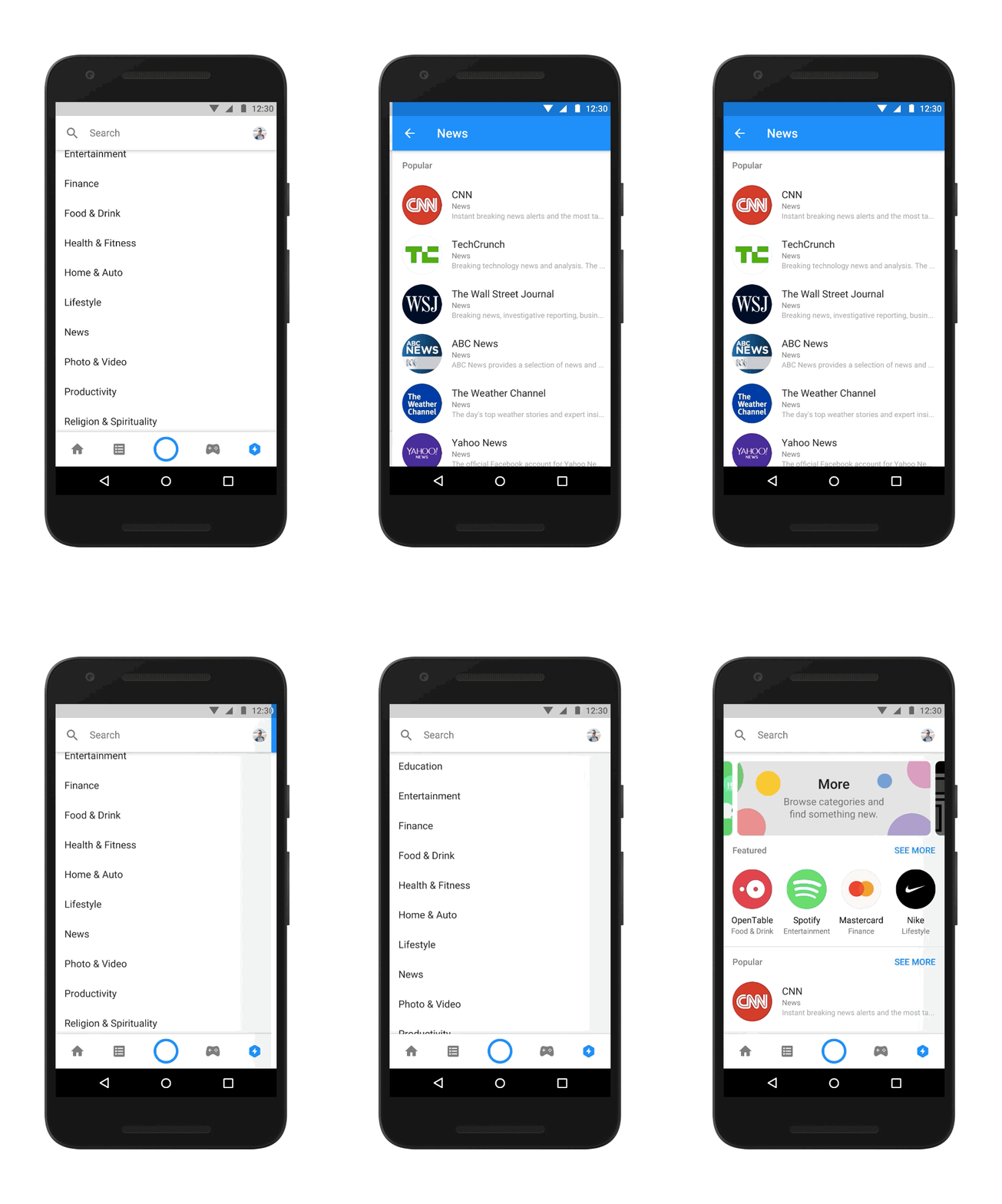
The Discover tab will feature content and bots from businesses and publishers, and you'll be able to search for specific bots as well.
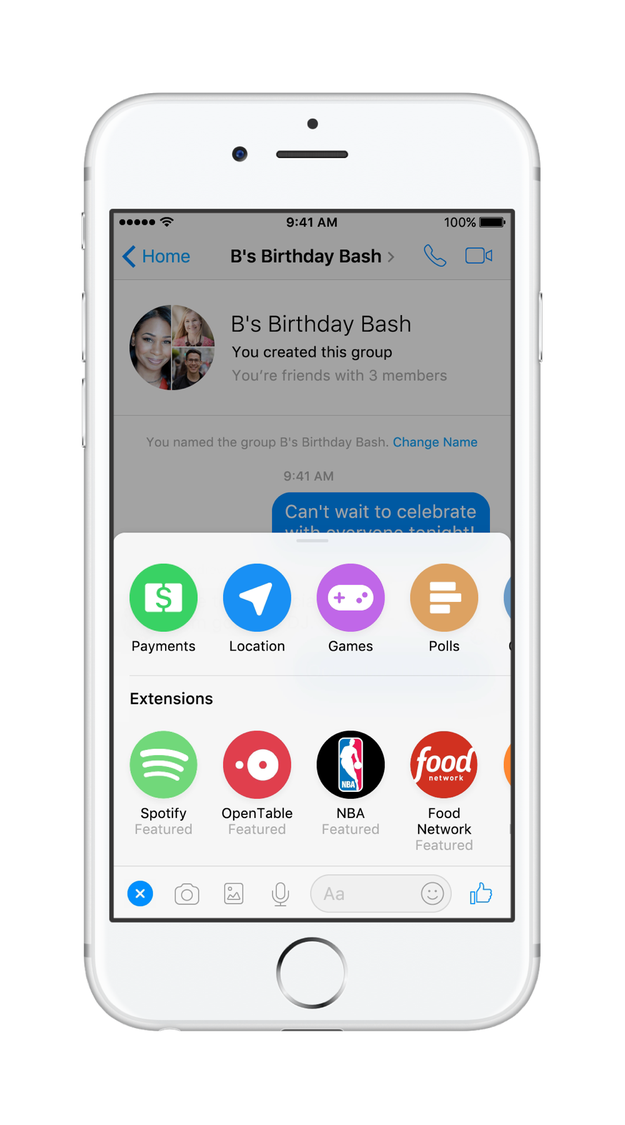
Those bots are apps inside the Messenger app. Facebook calls them "chat extensions" when they integrate into your messages.
For example: You can send songs via Spotify and play them within Messenger. (You can already send Spotify links to people, but the bot makes it a lot more seamless and keeps you in the Messenger app even while you're listening to the song.) The NBA, Food Network, and others have also made bots.
The Discover tab strongly resembles Snapchat's identically titled Discover tab. Facebook has also mimicked another signature Snapchat feature, Snapchat Stories, in all its social apps: WhatsApp, Instagram, the Facebook app, and Messenger.
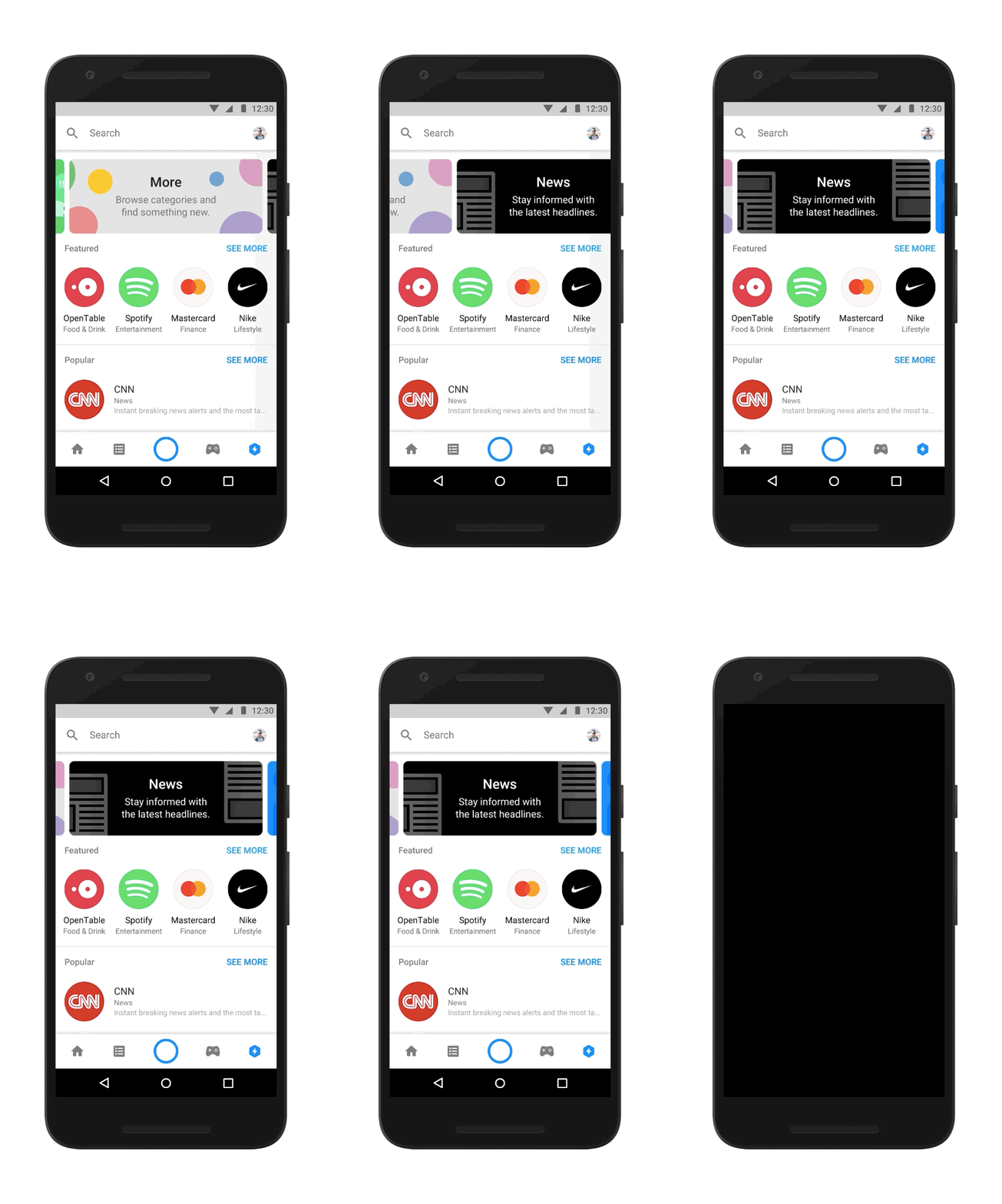
David Marcus, vice president of messaging at Facebook, said that the company developed the Discover page within the app to help with recommending relevant bots to users, something both developers working with Messenger and users have repeatedly asked for.
There's also a QR code reader for the Messenger camera that will allow you to jump to bots by scanning a code, much like Snapchat's Snapcodes allow you to jump to individual users.

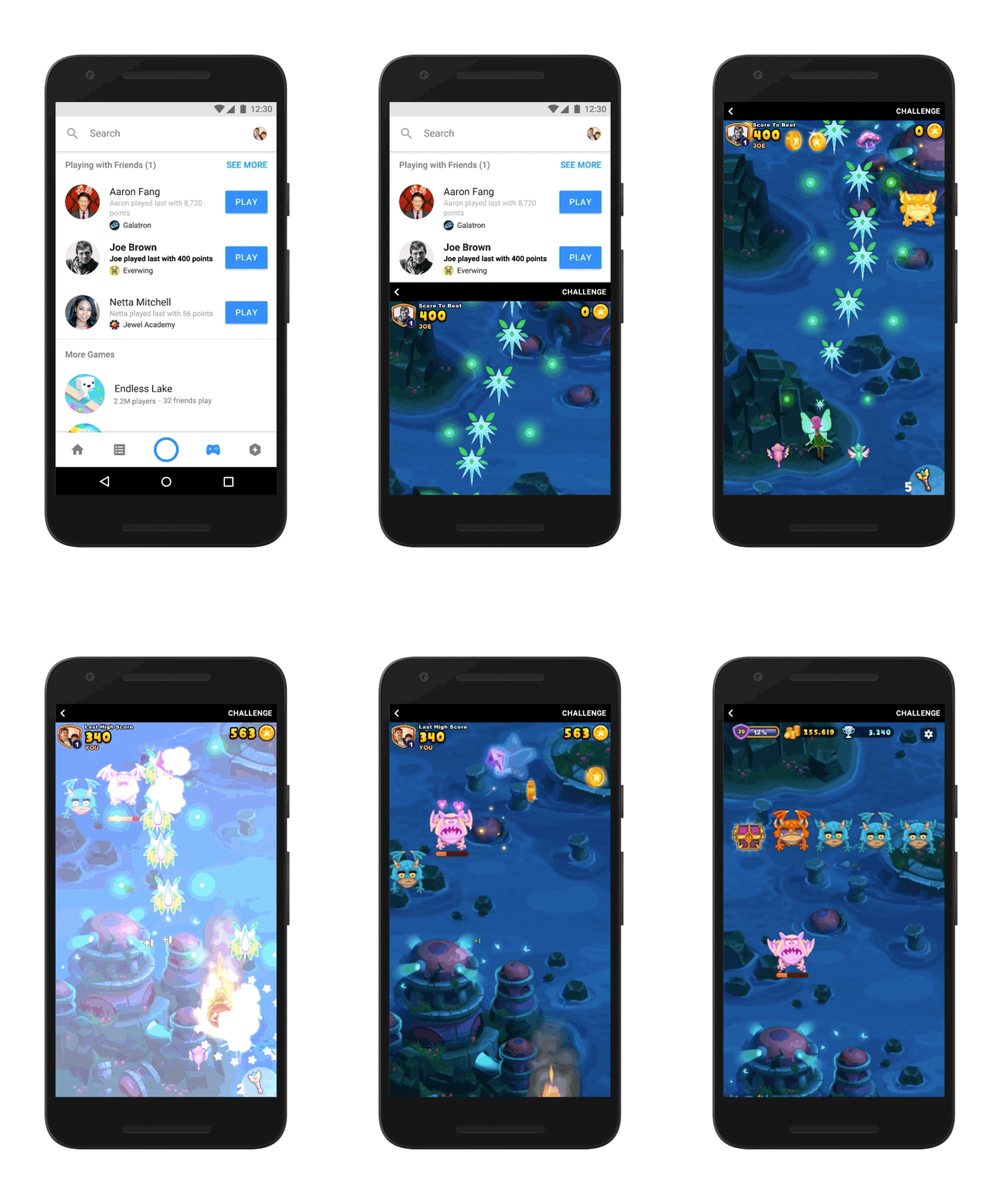
There's also a lot more games.
In fact, there's a whole new games tab, and you can now play turn-based games like Words With Friends within the app. The Messenger games before now were live-action games like Galaga or Pac-Man.
M, Facebook's virtual assistant, will be a lot more powerful.

Giphy
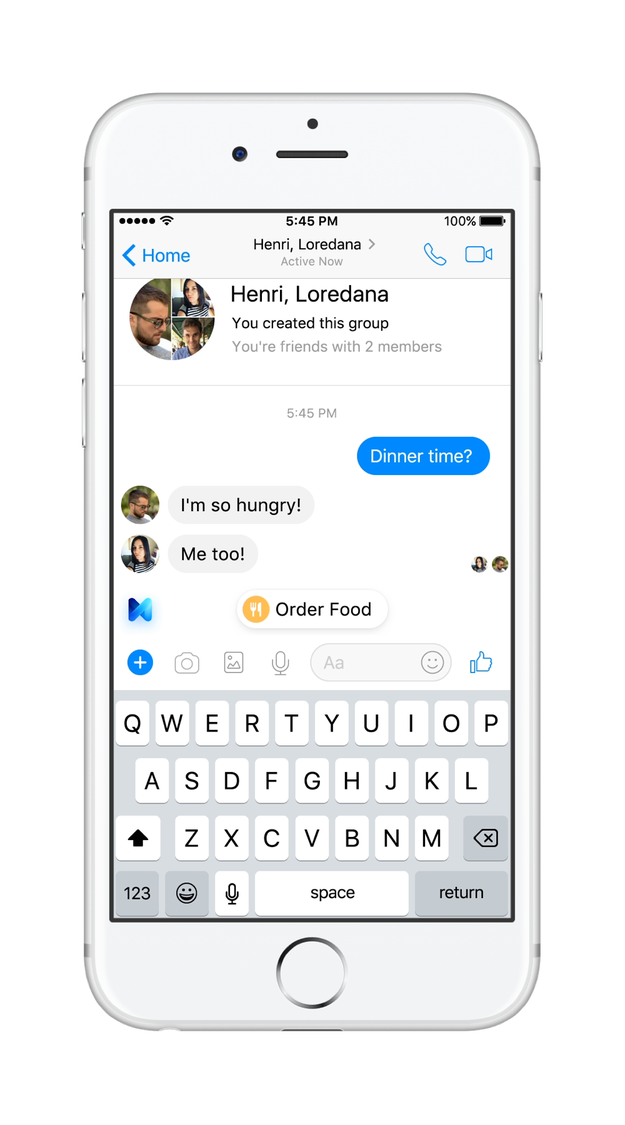
It'll now play a bigger role in your messages. Facebook says the virtual assistant will recognize when you're talking about specific tasks like meeting up at a certain time or picking a dinner spot. In response, M will offer suggestions like calendar reminders or food delivery options, which will be created by Facebook partners.
The 60 million businesses on Messenger will now have the ability to automate replies to frequently asked questions.
Think easy-to-answer questions like "What are your business hours?" or "Where are you located?" and other basic information.
According to Marcus, if the AI-powered business replier doesn't have an answer to a question, it will respond with "Let me get you someone who can help you" and alert the business's owners of the request. When the owners reply, Marcus said, the bot will digest the reply text and use it to reply to similar questions in the future.
Alex Kantrowitz contributed to this report.
Mark Zuckerberg’s Next Big Bet: Making The Real World An Extension Of Facebook

At F8 today, Facebook is announcing a bunch of utterly crazy shit that we'll soon be able to do to the pictures we take. That includes Facebook, WhatsApp, Facebook Messenger, and Instagram and affects, oh, somewhere approaching 2 billion people. But while the company is talking a lot about cameras, it would be a mistake to look at what it is rolling out as a mere photography tool. Yes, there are cool picture effects. But what Facebook is really trying to do is to fully insert itself in the real world. Facebook’s augmented reality camera effects are an early attempt to let the digital infiltrate the physical, a way for the company to become the conduit between everything you see in the world around you, and all the information that exists, via your smartphone.
“Facebook is so much about marrying the physical world with online,” the company’s CEO Mark Zuckerberg told BuzzFeed News in an interview late last week. “When you can make it so that you can intermix digital and physical parts of the world, that's going to make a lot of our experiences better and our lives richer.”
"Facebook is so much about marrying the physical world with online."
It is certainly going to make life weirder. At an earlier demo, when a group of 18 Facebook engineers gathered to show their work to an outsider for the first time, they were clearly nervous. One pointed his phone at a table, and a 3D propeller plane popped up on screen, circling around a water bottle that rested on the tabletop. Another used his phone’s camera to turn the room into a planetarium, with planets and stars hewing across the ceiling as shooting stars fired from side to side. Still another took a normal photo of a face — and then made it smile, frown, and gape with the push of a button. Little wonder they seemed on edge: The stuff they were showing off was wild and largely unprecedented.
This new Camera Platform, as the company calls it, is a major bet that the camera isn’t simply a tool used to capture images. It’s something you’ll use when you want to share photos and videos, sure, but also when you want to overlay digital experiences on the real world. Imagine, Zuckerberg urged, using Facebook’s camera to view pieces of digital art affixed to a wall. Or to play a digital game overlaid on a tabletop. Or to leave a digital object in a room for someone to later discover — perhaps even future generations. Imagine using your phone to take a 2D photo, and then transform that photo into a 3D space. Imagine manipulating a friend’s expression to make them smile, or frown, or, well, whatever. Imagine changing your home into Hogwarts for a Harry Potter-obsessed daughter. That’s what Facebook is doing. “We see the beginning of an important platform,” Zuckerberg said. Onstage at F8 Tuesday morning, he reiterated this point: “The camera needs to be more central than the text box in all of our apps. ... We’re making the camera the first augmented reality platform."
And you thought this was just about Snapchat.
AI at War
It’s easy to draw comparisons to Snapchat. And certainly the camera platform’s Snapchat-like effects are likely to grab the most attention early on. But the more interesting stuff that Facebook is trying to pull off involves layering the digital and physical worlds on top of each other — bringing the former into the latter, and vice versa. There will be three big augmented reality areas Facebook is pushing into. The ability to display information on top of the world in front of you, the ability to add new digital objects to your environment (think: Pokemon Go), and the ability to enhance existing objects.
For example, Facebook’s Camera can map out two-dimensional photographs in 3D. The company hopes developers will someday build digital products that behave and interact in those formerly 2D spaces, just as they would in the rich three-dimensional world we live in. Picture this: In one demo, Facebook showed off various 3D scenes created entirely from a handful of 2D photos. The scenes had real depth to them — you could peer around a tree in a forest, or tilt your head to see behind a bed in a room. With a few clicks, the lights went down in the room. The forest flooded with water. It was magic.
The demo was on an Oculus headset, but Facebook’s ambition is to bring these kind of scenes directly into the News Feed itself, no Oculus required. It wants people to be able to create and interact with them directly on their phones.
The ultimate idea here is to turn the real world into an extension of Facebook itself. “There's all these different random effects which are fun, but also foundational to a platform where people can create 3D objects and put them into the world,” Zuckerberg explained.
To pull off these radical camera effects, the company turned to an unexpected source: its AI team. When Zuckerberg began setting plans in motion for his company’s camera platform more than a year ago, he tapped Facebook’s Applied Machine Learning group (AML) to lead it. That put the technology in the hands of team artificial intelligence geeks, not the graphic designers or 3D artists you might otherwise expect.

While not a traditional imaging team, Facebook’s AML group does work extensively in visuals. Much of what the team does is in the AI discipline of computer vision, the science of training computers to analyze and extract information from images, the same way humans do (Think about the way Facebook or Google can identify a face or a landmark in pictures uploaded to them). The group’s computer vision expertise made it an ideal fit for a project predicated on understanding what’s appearing before and beyond a camera lens.
As Facebook’s AML group went to work on Camera last summer, it waded into a thicket of wildly popular rival camera products. Snapchat’s beloved selfie filters, for instance, had inspired hundreds of millions of shares and put the company on the fast track to a multibillion-dollar IPO. Meanwhile, Prisma, a photo app for iOS and Android, was using AI-powered effects to break down images and redraw them in the style of famous paintings.
Facebook promptly put its AML group on lockdown, a drop-everything-and-work-on-only-this measure the company sometimes uses when developing products it sees as highly competitive. Facebook famously went into lockdown to improve its site performance and user experience in 2011 following the debut of Google+.
Yet by the end of lockdown, the camera team had pulled off a significant feat: It had neural net–powered AI software working directly on people’s phones — not remotely on servers where this kind of stuff has traditionally operated. That meant Facebook now had the ability to read and manipulate images very quickly, and could create powerful camera effects that were previously infeasible due to computing limitations.
The first effect the team developed was one called “style transfers.” Like Prisma, it redrew photos as artwork, but unlike the app, it could do so almost instantly. The AML team created a green-screen effect that could pick out a person’s body and put all sorts of backgrounds behind it live in camera. It built filters that automatically identified common objects that might appear in images and created specialized effects for more than 100 of them: a heart-shaped cloud of steam that rises from a cup of coffee, a propeller plane that circles household objects, starscapes that transform a bedroom into a planetarium, and more.
The centralized camera team quickly became the de facto hub for camera effects across Messenger, Instagram, WhatsApp, and Facebook proper. Build once; deploy everywhere. “This is heaven,” Joaquin Candela, the head of AML, told BuzzFeed News. “We have this massive release channel and we’re just going to keep putting stuff in there.”
And Facebook won’t be alone in “putting stuff in there” — at least not if things go the way it hopes. Over the coming months, Zuckerberg said, the company plans to give developers (and to a more minor extent the public at large) a chance to use its tools to create their own filters and effects for Facebook’s cameras. Developers who want to build their own apps, games, and art will be able to do so, opening up a wide array of creative possibilities that Zuckerberg himself admits — and perhaps even hopes — will take Camera in unanticipated directions.
And in opening its platform, Facebook will give developers access not only to AML’s tools, but also to its multi-app, billion-plus-person release channel. “Even though they'll feel a little bit different in terms of features between Instagram and WhatsApp and Messenger, all the stuff that developers are going to build is going to be fundamentally compatible with cameras in all of these,” Zuckerberg said.
Snatch That
But, okay, remember when we said it’s not about Snapchat? Well, it’s also more than a little bit about Snapchat. Or at least, it’s certainly heavily Snapchat influenced.

In the past few months, Facebook has gone hard at its neighbor in Southern California, adding Snapchat-style ephemeral stories to Facebook, WhatsApp, Instagram, and Messenger. Snapchat, for its part, isn’t standing still, today releasing its own set of augmented reality effects, albeit underwhelming compared to Facebook’s. When BuzzFeed News asked Zuckerberg if he was happy with Stories’ performance in Facebook, and showed him an utterly barren Stories section on an account with more than 700 friends, the Facebook CEO swallowed, paused, and replied “it’s still early.”
True!
While Zuckerberg may urge patience, it’s likely his new camera platform will be judged in the early going by whether it can help Stories take off inside all Facebook products — not just Instagram, but Messenger, Facebook and WhatsApp as well. And the seeming failure of stories to gain traction inside places like the main Facebook app, or Messenger, raises the question of what truly belongs there. Because Facebook’s real power is in its network.
The same social graph Mark Zuckerberg talked about at F8 some 10 years ago — the one that connects you to your old friends, new acquaintances, high school teachers, and probably a lot of co-workers — remains its defining characteristic. The lesson of Snapchat seems to be that some things make sense on the big social graph, and some things don’t. And what will that mean for all this augmented reality? Are we really going to want to see flooded forests in our feeds?

And yet there is also this: A year ago, the social giant was in the midst of a small crisis, fending off a challenge from Snapchat which seemed to now own the fun, raw moments that originally gave social media its charm. Meanwhile Facebook proper was experiencing a decline in orignal sharing. In response, Facebook ruthlessly copied Snapchat Stories into all its products. And while Stories may seem like a wasteland in the main Facebook App, last week, daily users of Instagram Stories surpassed Snapchat as a whole (at least based on the latest numbers Snapchat provided). There are a lot of ways Facebook can use its network to win.
So, yes it’s still early. And yes, this may be a shot at Snapchat. But the war is for something much bigger. It’s about using the thing in your hand to analyze, interpret, explain, and fundamentally alter the way you experience the world around you. “We just view this of part of the first round of what a modern camera is,” Zuckerberg said.
Zuckerberg recalled telling his team a year ago that the path ahead of them wouldn’t necessarily be smooth. That they’d ship products missing many of the capabilities the company intended to develop down the road. And that they’d have to deal with whatever criticism came at them. “We're going to go through a period where people don't understand what we're doing. And don't understand the full vision,” Zuckerberg explained. “But, hey, that's the cost of entry to doing anything interesting.”
Mark Zuckerberg Just Addressed The Facebook Live Killer
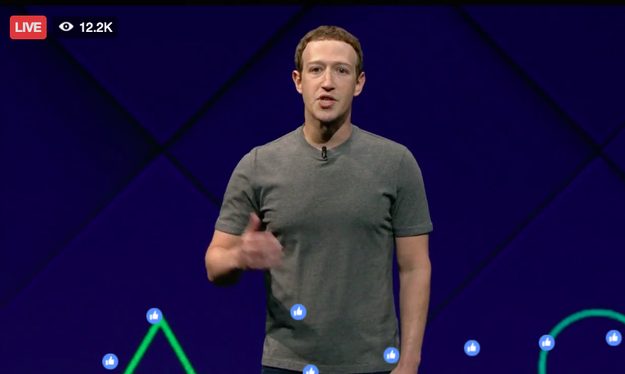
Today at Facebook’s annual F8 developer conference, CEO Mark Zuckerberg briefly addressed the murder that was broadcast on its platform over the weekend.
“Our hearts go out to the family and friends of Robert Godwin Sr.," Zuckerberg said, referring to the victim, a 74-year-old Cleveland man who the gunman, Steve Stephens, fatally shot on camera. “We have a lot of work and we will keep doing gall we can to prevent tragedies like this from happening.”
On Sunday afternoon, Cleveland police undertook a manhunt for Stephens. who uploaded video of himself shooting Godwin. "I just snapped man, fuck," Stephens says in another video from the day. Police announced earlier today that Stephens had shot himself to death in Pennsylvania.
More than1000 people watched the video of Godwin's murder before it was removed. In the days since, Facebook has faced criticism for not taking down Stephens' video and profile faster, as well as providing, through its much-promoted Facebook Live feature, a seamless way to stream violent video to a huge audience.
Zuckerberg did not go into detail about possible steps the company could take to prevent gun violence, or to prevent Facebook users from uploading or streaming gun violence to the platform.
The Galaxy S8 Is A Gorgeous Phone. Too Bad It’s Made By Samsung
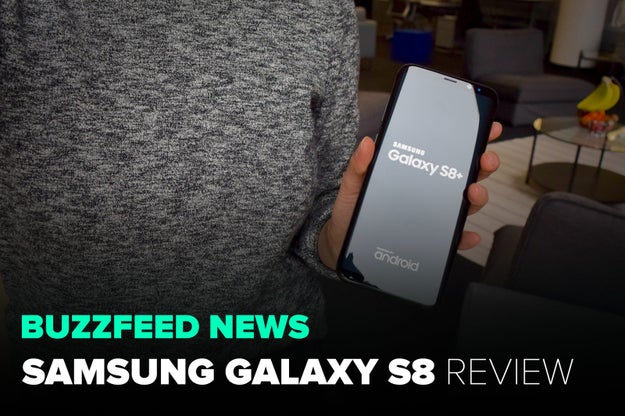
Nicole Nguyen / BuzzFeed News
No company was closer to being a trash fire in the past year than Samsung. There were the exploding Note7 batteries, then the exploding Note7 battery replacements, then the exploding washing machines, and then, finally, the exploding Samsung battery factory.
Needless to say, the Korean conglomerate, which recently lost its #1 smartphone maker ranking to Apple for the first time in eight quarters, is looking for a win.
Enter the Galaxy S8, the headliner of Samsung’s Redemption Tour.
During my five days of testing, the Galaxy S8 did not catch fire. In fact, the S8 turned out to be exactly what I had expected after my first hands-on: a gorgeous device with great technology inside. Samsung crammed as much screen into this phone as possible. The Galaxy S8 hardware is 83% glass slab and 17% everything else — and it has all the promise of an iPhone/Pixel killer.
The only problem? Like all Samsung phones, it’s pre-loaded with redundant apps and features you don't need. And, though the Galaxy S8 ships with the latest version of Android (7.0 Nougat), eventually the phone will be about five months behind Google’s future operating system updates.
All that aside, the S8 is a *really* good phone, and Samsung devotees with contract renewals coming up are going to want to upgrade ASAP. But those looking to switch will have a lot more to consider.
There’s nothing else on the Android market quite like it.
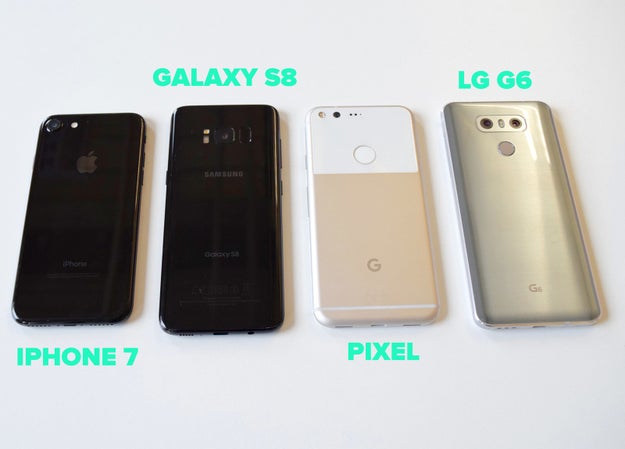
If you’re looking to get a new high-end Android phone right now, here are the three phones I think you should be considering: the Google Pixel, the LG G6, and the Galaxy S8. (For the purposes of this review, I’m not looking at Motorola, Sony, HTC, or Huawei. Don’t @ me.)
Aesthetically, it’s clear which one is the standout: the Galaxy S8. In my initial review, I loved everything about the Pixel, except its uninspired hardware design. LG’s G6 and its small, display-maximizing borders are, in many ways, similar to the Galaxy S8, but it’s a heavy phone that feels bulky.
Nicole Nguyen / BuzzFeed News
The S8, on the other hand, is wrapped in a slick, polished case. This is especially true of “Midnight Black.” It is Posh Spice wearing an all-leather catsuit and Samsung's other color offerings ("Arctic Silver" and the purplish "Orchid Gray") pale in comparison. The S8 looks modern and clean, and you’d be hard-pressed to find another Android phone with its looks.
The mind-bogglingly good edge-to-edge wraparound display is crisp and saturated, which we've come to expect from Samsung. The blacks are extra dark and text appears sharp, pixel-less. The display bleeds into the surrounding hardware, and it’s hard to tell where the screen ends and the phone begins.
The only “bezel” is a centimeter-ish border at the top and bottom. There are no physical buttons on the front of the phone, just a pressure-sensitive, virtual home button area. Every other leading Android phone maker has already removed the home button, and Samsung finally followed suit. To maximize the immersive screen experience, the home button is sometimes invisible (like when you’re watching a video full-screen or playing a game) and you can simply press down on the bottom of the screen to return to the main page.
These screens are huge. There are two models: the S8 with a 5.8-inch display and an S8+ with a 6.2-inch display; both are at 2,960×1,440 resolution. The viewing area has been increased by 36% from the previous versions, the S7 and S7 Edge.
But it doesn’t feel like you’re toting around a mini tablet. The nearly half a million extra pixels were added to the S8’s height, and its edges are curved on all four sides, so the phone is surprisingly grabbable.
The curved edges do, however, make texting with two hands in portrait feel a little cramped. When turned on its side, the phone is too wide for my hands to reach the keys in the middle. Perhaps big-handed users will have better luck.
It’s a very tall phone (nearly 6 inches for the S8 and slightly over 6 inches for the S8+), so enabling the phone’s “one-handed mode” has proven very useful for me. You can swipe your thumb diagonally from either bottom corner to use a mini, more manageable version of the software. Although, my frequent use of this feature reveals that perhaps I don’t need a big screen at all?!?!
Nicole Nguyen / BuzzFeed News
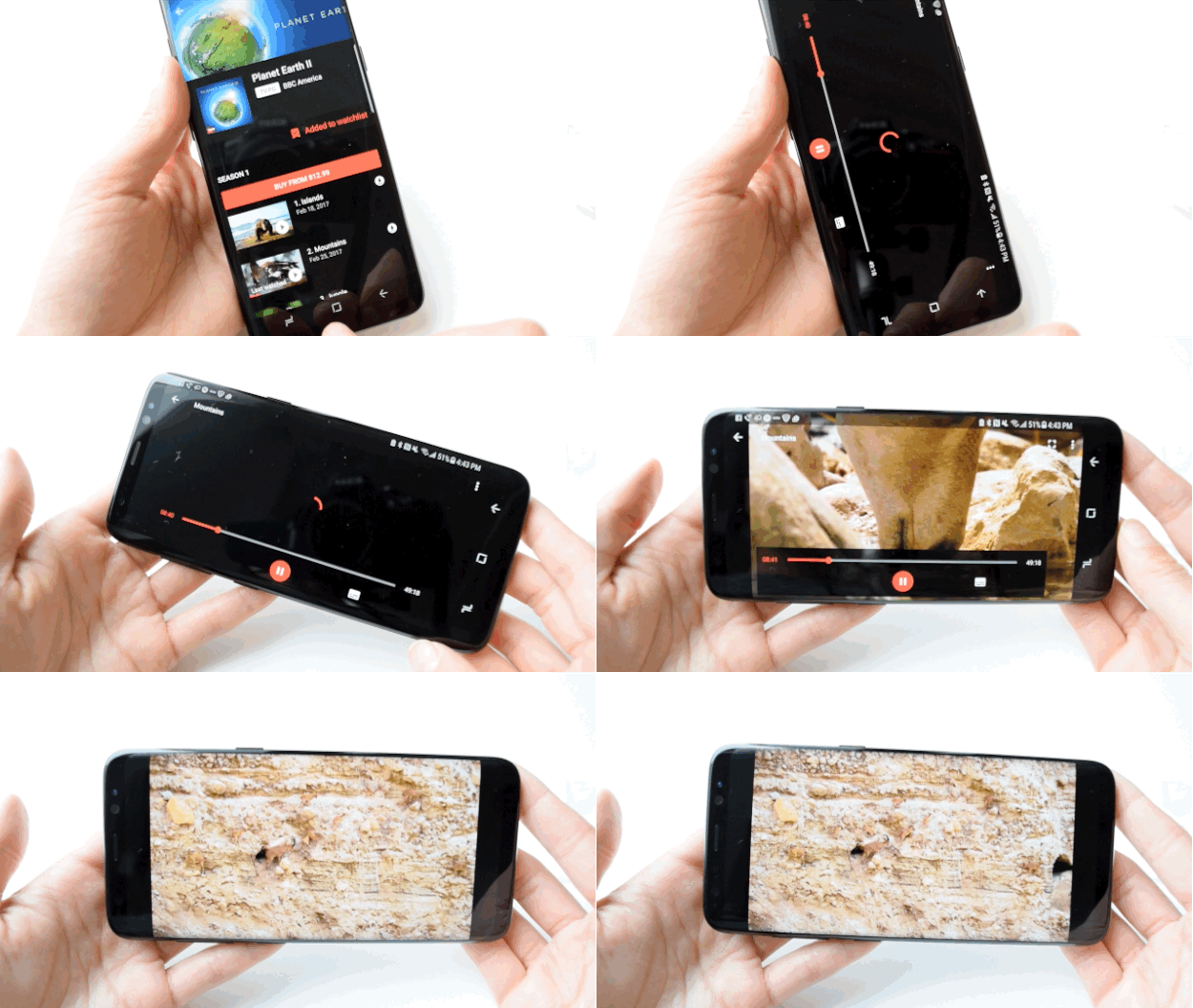
Apparently the S8 is “mobile HDR premium certified,” which means that when you watch shows or movies, you see the same colors and contrasts “that filmmakers intended,” according to Samsung. So I did what any other reviewer would do “for journalism”: I bought the Planet Earth II “Mountains” episode and poured myself a glass (or three) of wine (spoiler alert: ibex goats are badass AF). The display is very bright and vibrant — good for getting into Planet Earth, but ultimately worrisome because I fear it will eventually burn my eyeballs to a crisp.
The S8 is 83% screen, so it’s only fitting that this review is also almost 83% about the screen. Here comes the other 17%.
I tried my hardest to trick the S8’s face recognition unlock, but to no avail.
Reports that Samsung’s face recognition technology had been defeated with a photo surfaced last month. I tried to replicate this with a printed-out photo, with a photo onscreen, and with a Photobooth video of me staring at the camera and blinking. The phone was unfazed. I will never be a hacker.
Trickery aside, face recognition is more a matter of convenience than security. It makes up for the awkwardly placed fingerprint sensor and I found myself relying on it quite a bit.
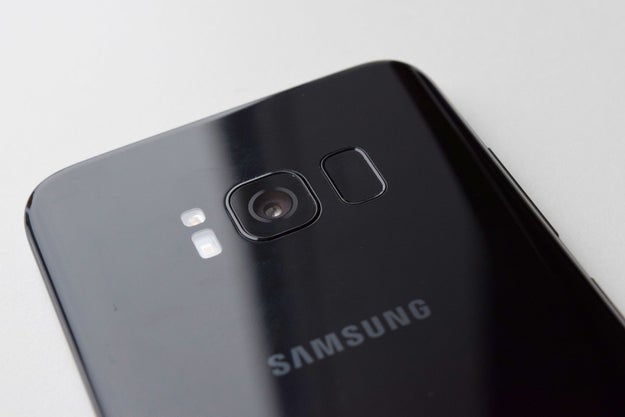
The fingerprint sensor has moved to the back, much to my chagrin.
Nicole Nguyen / BuzzFeed News
The fingerprint unlock feature has traditionally been programmed into the device’s home button. Seeing as the S8 ditched the button, it’s now on the back of the phone. The S8’s fingerprint sensor and the camera feel basically the same, which means I kept smudging the camera lens and unlocking the phone at the same time. It’s really too bad because, minus the finger smears, the camera is quite good.
Speaking of the camera, it’s the same as the Note7’s and the Galaxy S7 before it.
The phone’s rear camera hasn’t changed. It’s a 12MP lens with f/1.7 aperture, and it notably does not have the “dual lens” setup (a camera with two lenses) that Apple, LG, and Huawei introduced with their most recent flagship devices. But I didn’t really miss it in the S8.
Samsung likes to tout its primary camera’s low-light capabilities and fast auto-focus, even with motion. At full zoom, it handled capturing this surfer fairly well (in the rain!):
And this darting newt:

Nicole Nguyen / BuzzFeed News
And this amazing lemon poppyseed bundt cake my friend Lauren made:

Nicole Nguyen / BuzzFeed News
The real news is the S8’s upgraded front-facing camera, which is now 8MP (up from 7MP in the Note7) with the same f/1.7 aperture. Here’s an unedited Samsung selfie:

Nicole Nguyen / BuzzFeed News
And an iPhone’s (the iPhone’s camera is just 7 megapixels):

Nicole Nguyen / BuzzFeed News
The main difference is that, because it’s a higher-resolution image, you can zoom in more on the Samsung selfie. I've showed these photos to multiple people — and votes are split right down the middle. The look of a photo is ultimately a matter of preference and I will let you, Internet, be the final judge.
There are also new Snapchat-style stickers built-in, which…sigh.
Nicole Nguyen / BuzzFeed News
Bixby, the S8’s artificially intelligent assistant, is kind of...dumb right now.
Samsung created its own version of Alexa, Siri, and Google Assistant. It’s called Bixby, and it’s really an umbrella term for three different “intelligent” features: computer vision/image recognition software, a voice-enabled assistant, and a namesake app called Bixby that shows you different personalized “cards” that offer information like weather and upcoming flights (essentially this Google app feature).
Bixby Voice
What makes Bixby different from other assistants is that anything you can do on your phone with touch, it can allegedly do it with your voice instead. You can say things like, “Set display brightness to maximum” and more contextual requests like, “Rotate this photo to the left.” Unfortunately, Bixby Voice doesn’t launch until later this spring and I didn’t get to test it out myself.
Bixby Vision
I was, however, able to try Bixby’s vision recognition software, which uses the phone’s camera to “see.” For example, you can hold up a QR code and Bixby can take you directly to the link, or you can scan a business card and Bixby will isolate the text, then automatically add a contact from the camera app. It does those two things perfectly fine, but it’s not exactly groundbreaking tech. There are plenty of apps that can do the same thing.
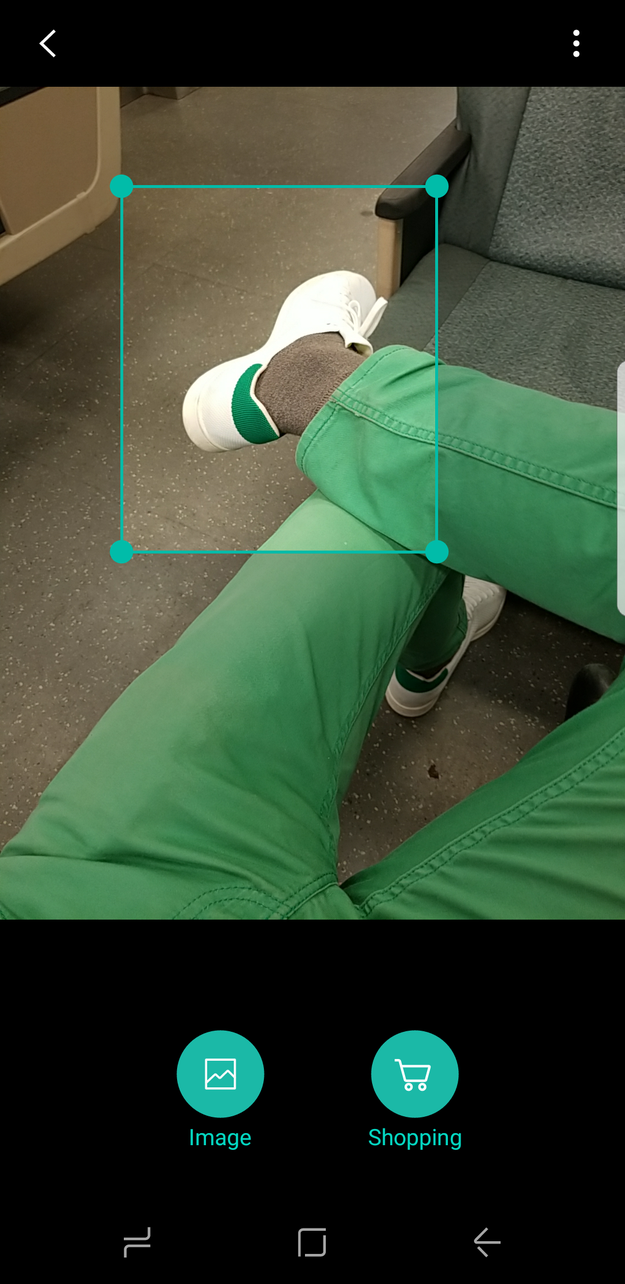
One of the seemingly cooler features is being able to point your camera at a piece of furniture or clothing so Bixby can use use Pinterest-powered computer vision to find out where to buy it. I was excited to try this and hoped it would eliminate “where did you get that” small talk with more stylish ladyfriends.
Nicole Nguyen / BuzzFeed News
But when I tried it out (on my boyfriend’s white Adidas shoes and a pair of amazing culottes), Bixby showed me Amazon results that matched the general shape/generic version of what I was trying to search for — and nothing else. In fact, for the culottes, Google reverse image search fared much better and found a Pinterest pin with the specific brand in the description (they are Oak+Fort, btw). I then tried taking a pic of the pin with the hopes that the Pinterest-powered software would pick it up. Nada.
Bixby Vision results are like asking your mom for a custom American Girl doll that’s designed to look just like you, and getting a Secret Hero Mulan from a KB Toys closeout sale instead.
Bixby App
I didn’t find the Bixby app too helpful. It showed me details for an upcoming flight and the week’s weather, plus trending topics on Facebook, which was cool. There was a random puppy napping GIF from Giphy as well, though I’m not sure if that was personalized content.
Right now, it’s hard to assess whether Bixby is a success, because so much of the technology is still in development. As it stands, Bixby is a gimmick that’s fun for showing off to friends but not smart enough to actually be useful. Plus, Google Assistant, which ALSO comes with the S8, can do just about everything Bixby can do and then some.
The battery didn’t explode.
The 3,000 mAh battery in the S8, the version I tested rigorously, performed well. The phone, as I’ve previously mentioned, is all screen, so it isn’t surprising that the display was my #1 battery suck for three days in a row.
The phone’s battery takes about an hour and 40 minutes to fully charge via USB-C cable, and has lasted me about a day and a half on average. This is with reading articles in an hour-long round-trip commute, watching 30-minute videos, followed by 30 minutes of gameplay, and with the usual slew of Facebook and email notifications enabled. Batteries, of course, decay over time, so I’m not sure how long that’ll last. I’ll update this review if that changes.
It feels fast enough.
The Galaxy S8 is the first device to ship with the newest Qualcomm processor: the Snapdragon 835, which is faster than its predecessor (the Snapdragon 820) but uses less power than other chips. The phone felt zippy during this first week of testing, but, like batteries, its processor will decay over time.
I played Super Mario Run, a casual sidescroller, and CSR Racing 2, a 3D graphics-intensive racer, a LOT during the testing period. They played smoothly and didn’t significantly drain the battery.
The processor is apparently robust enough to power a computer, using the new Samsung Dex portable dock accessory (price TBD) that can be hooked up to a monitor, keyboard, and mouse. The dock essentially turns the phone into an instant, lightweight Chromebook — in the demo I saw, the phone ran two apps simultaneously. I didn’t get to test the Dex out either, but once I do, I’ll update this review.
And now, a rant.
As gorgeous as the hardware is, the S8 is a Samsung phone, and I can’t review this device without noting this disclaimer: Samsung phones are (still) filled with so much crap. Samsung’s OS (called “TouchWiz”) looks cleaner than ever before, and it’s getting better. But it remains full of bloatware.
For example, I tested a T-Mobile version of the device. Right off the bat, there are four T-Mobile apps on the homescreen that I’ll likely never use, including "T-Mobile TV." Then there are Samsung apps, like the mobile browser aptly named “Internet,”plus the Google versions of those exact same apps, like Chrome, already installed. There’s Android Pay, and Samsung Pay. There’s Gallery, and Google Photos.
Then there are Galaxy apps (which are apps made by Samsung or special “themes” to customize how your phone looks), in addition to apps you choose to download from the Google Play Store. There’s a dedicated side button for Bixby Voice, and OK Google can be activated by longpressing the home button. It’s a hot mess.
All of this is pre-loaded on the phone — and I know it can be removed from the home screen or uninstalled, but…ugh!
Samsung deeply alters the Android experience, down to the way windows scroll in the app switcher. You’ll see on the Pixel that there’s a smooth, continuous scroll and on the S8, a clunkier unit scroll.
David Karp Talks About Tumblr’s New Video App
Today, Tumblr, the social network for teens and people who like erotica of Sherlock Holmes as a fawn, is launching Cabana, a group video chatting app where you can watch YouTube videos with up to six of your friends. It’s fairly straightforward – you can just chat as you watch videos and see your buddies’ faces as they react.
Watch YouTube videos with up to 6 other people:
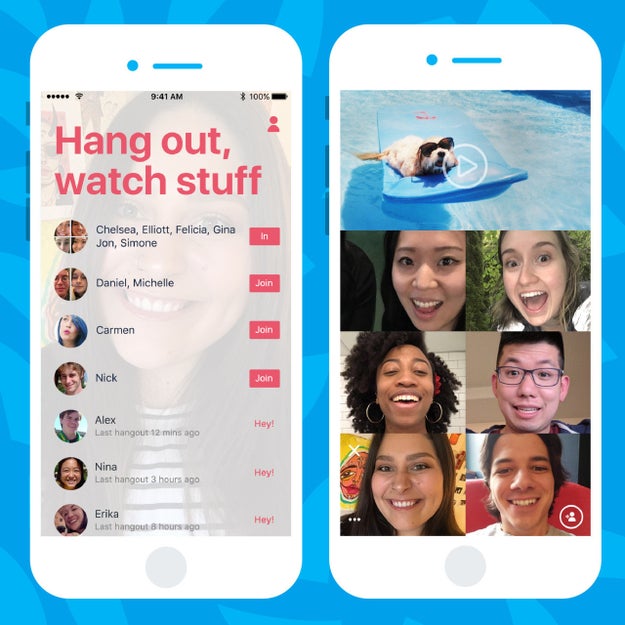
Cabana is currently iPhone only, but an Android version will come soon. It also supports YouTube but plans on adding other video partners.
Tumblr
It’s the first standalone app that Tumblr has made, and it’s pretty different from Tumblr. Tumblr is mostly for consuming and sharing stuff in a community of strangers – often anonymous – who share the same interests (say, the same Korean boy band, or drawings of Sherlock with antlers). Cabana is for talking face to face with 5 of your friends.
Tumblr and Polyvore Labs, which are both owned by Yahoo, developed Cabana. Right now, the app doesn’t have ads or monetization, but Tumblr CEO David Karp says that will happen further down the line. Which means that Cabana isn’t just a fun thought experiment with the Labs team — it’s meant to be a much-needed stream of revenue.
Tumblr has had some trouble since Yahoo bought it for a billion dollars in 2013.v Last year, Yahoo wrote down Tumblr as a $482 million loss. A a report last week showed that teens are dropping smaller social platforms like Tumblr and consolidating their activity on bigger platforms like Facebook, Instagram, Twitter, and Snapchat. All these networks have made video their priority, particularly live streaming video. The Verge points out that Facebook is losing interest in Instant Articles [other people’s text content] and their latest mantra is “the camera is the platform”. Tumblr does have a live video, but it’s not part of the core Tumblr experience.
BuzzFeed News talked to Tumblr’s David Karp and Jason Lee of Polyvore Labs, the team at Yahoo that created the app. [This interview has been edited and condensed for clarity.]
Tumblr
Tumblr has always been a little anonymous and a way to reach people you don't know in real life. Cabana’s different — it's for a small group of people who want to see each others' faces. Do you see a shift from anonymous people blasting their stuff out, to small groups of people privately sharing stuff? Is this a new thing, where you want to hang out with six people instead of 600?
David Karp, founder and CEO of Tumblr: Tumblr is not about you going into a room with people that you know in real life and talking. It's about whole communities of people who don't know each other yet coming around the things that they both care about tremendously and getting to know each other. So Cabana is a different approach and way to think about social networking.
I think why Cabana felt so close to the Tumblr community and experience is that so often you're discovering stuff on Tumblr, and you want to reach out to all your buddies and show them this thing that you found. Sometimes a reblog is enough – you just want to put it out there to your followers. But every so often, you find something where you're like, “oh my god, my girlfriend or my buddy at work or school has to see this, like, right now,"
Sure, you can share a video over text or email. But the [better] experience [is] finding that extraordinary video that's fascinating or hilarious or profound, and dragging your friends over to your computer to watch, or pulling it up on your phone and putting it in their faces so they see it. Being there while they watch it for the first time – that experience of watching them experience it for the first time – that's a human experience that everybody's gone through at this point.
That’s not really captured anywhere else in any other app on your phone right now. This just gives you a place to do that with all of your best buddies, even when you're not there in person sitting next to each other.
Why a separate app?
Karp: Cabana is really an experience based around groups of people who know each other already that are coming together around a thing one of them might be obsessed with but the rest of them haven't found yet. They get to bring their buddies into the know on, or be there when their buddies experience it for the first time. That is a pretty differently shaped network than Tumblr is today.
Jason Lee, director of product management, Polyvore Labs: We were doing user testing for Cabana on Tumblr users, and it resonated really well them. When I shared this with David, we both looked at the product and at each other and said, “well this is really cool and would fit well under the Tumblr brand and audience,” and it snowballed from there.
When Yahoo wrote down Tumblr last year, how did that feel on a personal level?
Karp: I think more than anything, I used that as an opportunity with the team to look forward to everything that we still had to do, [that] we’re still excited to do and we’re working on. Those moments are obviously always frustrating and bruising; we've had plenty of those in our 10 year career here, but not enough to slow us down or discourage us from everything that gets us up every morning and gets us excited to be working on this product and community.
Do you think that enough time has passed since 2 Girls 1 Cup that a whole new generation is ready to experience it on Cabana?
Karp: Well, I think that's a pretty weird example. I can happily say I was never on the giving or receiving end of that video at any point. But yes, it’s that broader experience of wanting to see how your friends react to a thing that's hilarious or hugely profound. Or if a video is going viral, and you want to be the person who shows your friends first.
Lee: One of the first videos I showed David when we were testing this was one of those "fail" compilations, and we just sat there laughing together. We're on different coasts, but we're synchronistically
watching this video, and we're laughing at the same times. It was no different than if we were in a room together and watching something on a bigger screen.
Monday, April 17, 2017
27 Things Everyone Hates With A Passion But Would Never Admit
They suck.
The horror:

The confusion:

The fear:

The panic:

Furious Indians Are Leaving Snapchat One-Star Reviews In The App Store Because They're Mad At The CEO
A former Snap Inc. employee has claimed that CEO Evan Spiegel allegedly said that he didn’t “want to expand into poor countries like India and Spain.”
A former Snap Inc. employee has claimed in a lawsuit that CEO Evan Spiegel said that Snapchat was “only for rich people”, and that he didn’t “want to expand into poor countries like India and Spain."

Lucas Jackson / Reuters
The news was reported by Variety earlier this week.
In a statement provided to BuzzFeed News, a Snap Inc. spokesperson said: “This is ridiculous. Obviously Snapchat is for everyone! It's available worldwide to download for free."
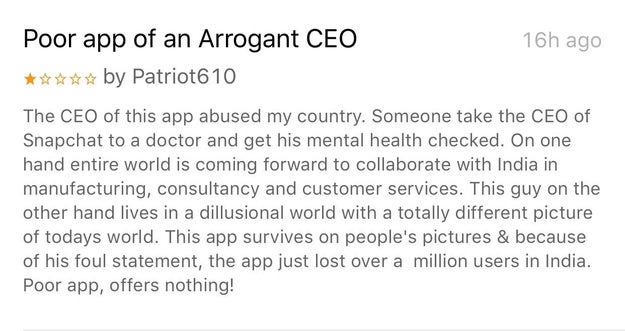
Over the weekend, however, Indians battered the Snapchat app with angry reviews and poor ratings in the Indian App Store.
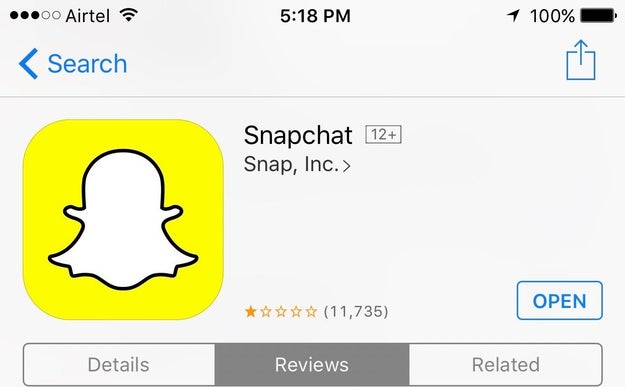
BuzzFeed News screenshot
They called Spiegel "delusional"...
App Store
Sunday, April 16, 2017
24 Seriously Annoying Things That Happen In Every Sex Scene
So. Much. Rolling.
Heads up: These responses mostly refer to heterosexual sex between cisgender men and women — because the representation of LGBT sex on screen is a whole other can of worms.
First of all, no one ever talks about protection or birth control, because apparently, pregnancy and STIs are not a concern.

Is every woman on the pill? Is it just assumed that every couple discusses their STI statuses in between the hot and heavy groping session in the elevator on the way to have passionate wordless sex in the protagonist's apartment?
Paramount Pictures / Via buzzfeed.com
And no one talks about what they want at all. Everyone just communicates through lusty eye contact and ~knows~ immediately what the other person likes.

WHO NEEDS VERBAL COMMUNICATION, AM I RIGHT?
The CW / Via spn-party.livejournal.com
In fact, nobody seems to be worried about consent in general. It's just kind of assumed everyone wants sex all the time.

Focused Features / Via fiftyshadesofgrey.wikia.com
Airline Tech Keeps Melting Down But Nobody Knows Why

Joshua Roberts / Reuters
Last week, a severe thunderstorm in Atlanta forced Delta to begin canceling flights out of its major hub. But that storm quickly spiraled into a five-day fiasco that resulted in 4,000 canceled flights and plenty of angry customers. The culprit? A failure of technology.
When airlines cancel flights, schedulers play musical chairs behind the scenes to redirect crew members and pilots to where they’re needed. In Delta’s case, as the company delayed and canceled thousands of flights, its systems couldn’t handle the pressure.
This wasn’t the first time Delta experienced a meltdown of this kind. Back in August, after a power outage in Atlanta knocked its systems down worldwide, forcing the company to cancel more than 800 flights. The company canceled another 300 flights in January, citing another “system outage.” And it’s not just Delta: United grounded some flights in January, and Southwest delayed more than 930 flights in December – with both airlines blaming computer problems.
So why are airlines’ computer systems consistently crashing, and why couldn’t Delta’s keep track of its crews during a crisis?
In the case of Delta’s recent incident, the issue was that its crew management system was overwhelmed – not that its computers crashed outright. In a memo to staff on Monday, Delta CEO Ed Bastian said "Our recovery was hampered by a lack of available seats to accommodate customers as well as a failure of crew tracking systems to adequately position our people to do their jobs.” On an earnings call on Wednesday, Bastian said Delta plans to invest more heavily in technology that will help the airline track crew members. The airline also said in a presentation to investors in December that it plans to invest $450 million in technology in 2017.
Bob Edwards, a former chief information officer for United Airlines, said it appears from Bastian’s comments that Delta’s crew tracking systems “don’t have the ability to rapidly optimize and reschedule” staff after flights are canceled, particularly at the large scale Delta faced last week.
“It’s a system that’s not designed to handle that magnitude of chaos,” Edwards said. “Because Atlanta is a weather-friendly hub, Delta doesn’t have the need to practice major weather recovery...I don’t know if Delta has made the same investment in technology to help the airline recover and recover quickly when something like this occurs.”
“Maybe they should've made the investment, but they haven't,” speculated Edwards, who left United in 2014 and worked on IT systems at Continental Airlines before the two airlines merged. He called it “a failure of a business to give their employees the tools to handle an event like this.”
Part of the problem is also that nobody knows how often computer systems cripple an airline – or compound a disaster like in the case of Delta’s Atlanta issue. The Department of Transportation tracks domestic flight delays in five categories: late aircraft arrival, weather, security, air carrier delays and delays caused by the National Aviation System.
Delays caused by glitches or other airline tech issues fall into the “air carrier” bucket of problems, which caused 5.1% of national flights from January 2016 through January 2017 to be delayed. (That figure was 5.56% in 2015. When the DOT first began collecting data on the causes of flight delays in June 2003, that percentage was 4.3%.) But that category is broad and includes everything from late-arriving crews to delays loading baggage and meals or cleaning and maintenance of the airplane.
“Without data, it’s really difficult to study this,” Vikrant Vaze, an assistant professor of engineering at Dartmouth who has researched airline-caused delays, told BuzzFeed News. “Nobody tracks it.”
Still, headlines suggest that airlines are struggling as a result of computer-related issues, Vaze said. “Anecdotal evidence suggests that the resiliency is lower than what it should be.”
The Department of Transportation doesn’t track delays or cancellations that result from computer outages because they do not affect safety, a spokesperson told BuzzFeed News. Airline computer systems that manage reservations or check-ins are separate from those that run the aircraft and communicate with the Federal Aviation Administration.
“Airlines are already highly motivated to avoid computer glitches, which can cost airlines millions of dollars in grounded aircraft and crews, and services, compensation, and refunds to passengers,” a DOT spokesperson told BuzzFeed News in November, during the Obama administration. (The Trump administration’s DOT did not return a request for comment.) “Reduced on-time performance totals could also impact future bookings. Avoiding such costs is likely a more effective incentive than detailed regulations concerning the carriers’ IT systems.”
In August, US Senators Ed Markey of Massachusetts and Richard Blumenthal of Connecticut, both Democrats, sent a letter to 13 major airlines, asking for information about recent technology-related outages, and a list of all the instances in the last five years. Airlines’ responses to their questions have not yet been released.
Many argue that airlines have little incentive to improve their operations — after all, a series of mergers in recent years have led to little competition for business.
“The airlines aren’t necessarily forced to innovate in certain ways,” said Megan Ryerson, assistant professor of city and regional planning and electrical and systems engineering in transportation at the University of Pennsylvania. “This meltdown that happened to Delta would not stop me from flying them if I lived in Atlanta. What is incentivizing them to improve their systems?”
Friday, April 14, 2017
Instacart Is Testing A New Interface For Tipping
Instacart is testing an interface that makes the ability to tip delivery workers more obvious.
For now, the test hasn't been spotted in the app itself, but in the receipts emailed to customers. So far, only customers in Chicago and Boulder, Colorado have reported seeing it.
The new look — which features more prominent tip buttons and larger photos of what Instacart calls "shoppers," the workers who deliver your order — follows a $4.6 million legal settlement in which Instacart promised to make the difference between its service fee (which is collected by the company) and tips (which go directly to workers) more clear.
Here's how email receipts from Instacart usually look, with a small button that says "Rate & Tip":
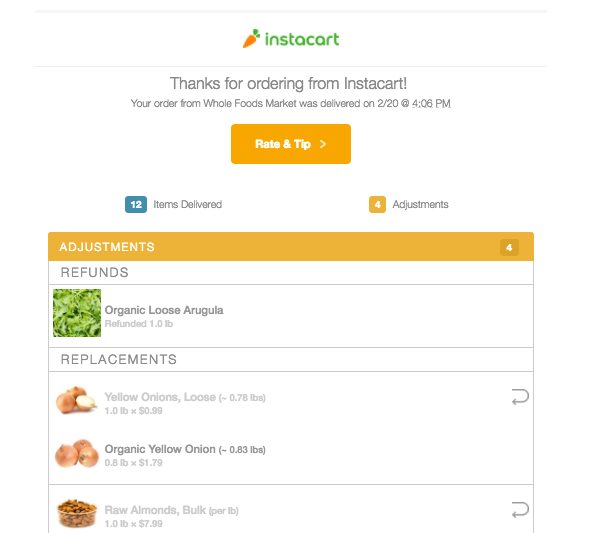
And here's how they look in the tests, with a big photo of the delivery person who's getting the tip, and much more prominent tipping options.
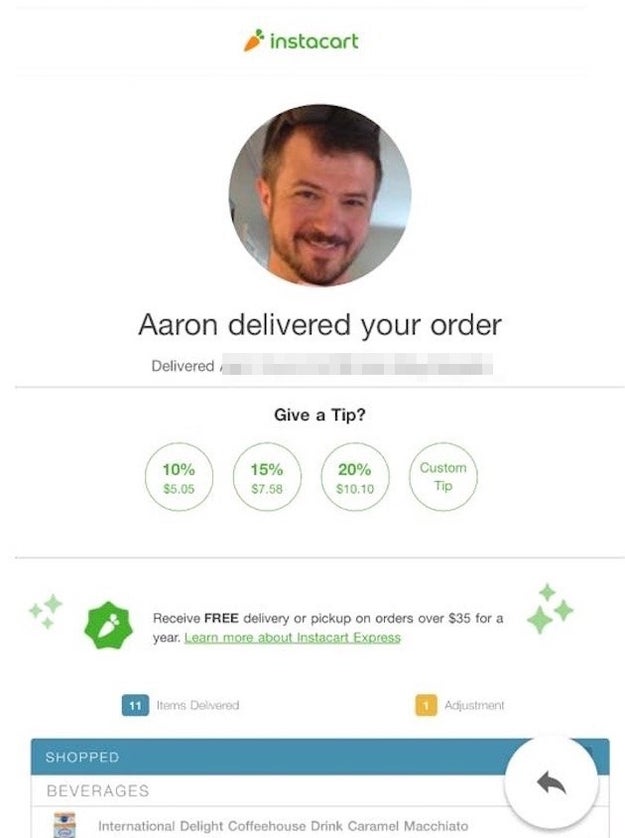
Instacart says the test is unrelated to the conditions of the legal settlement.
Delivery workers who shop for Instacart have been frustrated with the company since six months ago, when it replaced tips with a service fee collected by the company. It's still possible to tip on Instacart, but workers say changes to the app interface made it harder for customers to figure out how; as a result, they say their earnings have taken a permanent hit.
This dispute became a factor in a class action lawsuit workers brought against Instacart in December. According to the terms of the settlement Instacart reached last month, here's what the company promised to do:
As soon as is practical after the effective date, and following product review and testing, Instacart will modify the existing user interface related to the service fee to provide additional information to customers regarding the nature of the service fee, and the difference between the service fee and tip.
Some shoppers who saw screenshots of the new email receipt interface in a Facebook group for Instacart workers said they were hopeful that it would lead to higher tips. Many said they'd be updating their profile pictures, based on the size of the photo in the email.
But others, including Chicago shopper Matthew Telles, were worried that the test doesn't go far enough; he said only restoring tips as the default option in the app will be satisfactory. "The only thing that's going to get tips back to an adequate level is putting the tip in place of the service fee at checkout," he said.
Blue Apron Has Been Fined For Safety Violations. Again.

Bree Fowler / AP
A little over a year after being cited for a “serious” safety violation, the $3 billion meal-kit delivery startup Blue Apron again failed to comply with regulations.
The first “serious” violation for Blue Apron’s Richmond, California facility came after an August 2015 inspection; per California Division of Occupational Safety and Health (CalOSHA) standards, a “serious” violation means the inspector thought “death or serious physical harm” was a “realistic possibility.” For that violation alone, Blue Apron was levied a proposed penalty of $9,000, which it contested.
That citation was surfaced in an October 2016 BuzzFeed News investigation into the history of health and safety violations at the Richmond facility. At the time, the company said it was committed to “creating the best possible workplace experience for all of our employees” and had “learned from the operational challenges during its early days in Richmond.”
But BuzzFeed News has learned that in September 2016, a little more than a year after the 2015 inspection, following an anonymous complaint, CalOSHA inspected Blue Apron’s facility again, and the company was once again cited for a “serious” violation. Inspectors found that Blue Apron had violated the same exact statute for which it was previously cited — a failure to install emergency shower stations near forklift battery charging stations — and proposed a penalty of $3,825. (The findings of the inspection were not made public until February 2017.)
In addition to the “serious” violation, Blue Apron’s California facility was also cited for an additional five safety violations; the total proposed penalty is $6,580.
In a statement emailed to BuzzFeed News on Wednesday, Blue Apron said it “promptly addressed” the initial 2015 citation, and that the new citation is in regards to a new forklift battery charging station that was constructed during an expansion of the facility. When CalOSHA inspected the Blue Apron facility post-expansion in September 2016, inspectors found that while Blue Apron had installed an eyewash station near the new charging station, they had not installed an emergency shower.
“We promptly installed a shower at this location as well to address their concern,” said a Blue Apron spokesperson via email. “However, we believe both citations were issued in error, and Cal/OSHA is currently reviewing them.” Specifically, Blue Apron is arguing that, because the company doesn’t change out forklift batteries at the charging stations in question, per CalOSHA’s standards, the emergency showers were not necessary.
The appeal for the 2016 citation is set for July 2017; the appeal for the 2015 citation is currently scheduled for May.
Blue Apron has also recently run into trouble with health and safety regulators outside California. According to a public OSHA database, Blue Apron’s Jersey City, New Jersey facility — which has been plagued by some of the same internal violence among employees as its California counterpart — was most recently inspected in December 2016, following an anonymous complaint. According to its website, OSHA found one violation at that time, and issued a proposed penalty of $2,000. Blue Apron says it’s not contesting the citation in New Jersey, but added that it was actually fined $1,000; the higher fine listed online, it says, reflects a paperwork error.
Blue Apron is reportedly hiring bankers in preparation to go public, despite reports in December that its IPO would be delayed. The company also recently acquired an organic cattle ranch in California, in hopes of owning and controlling more aspects its meal-kit production system.
Subscribe to:
Posts (Atom)


